

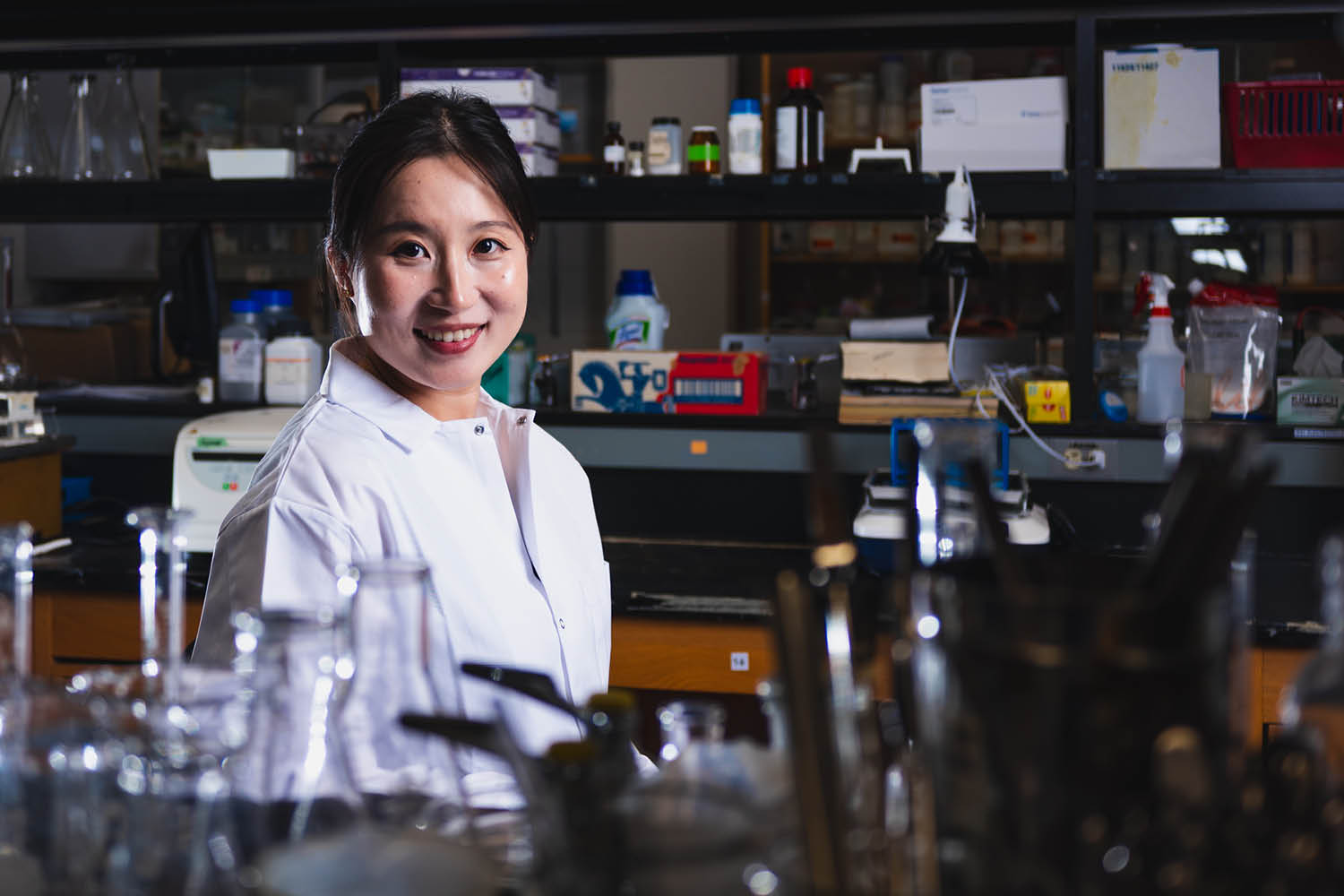
The science behind safer food
How Dr. Kaidi Wang (PhD) is fostering a safer Canadian food supply through food microbiology, rapid detection technologies and applied research.
By Delaney SeiferlingWhen Dr. Kaidi Wang (PhD) began studying food science and engineering as an undergraduate in China, she was fascinated by the science behind how food is produced, processed, preserved and ultimately reaches our plates.
Then, a series of high-profile foodborne illness outbreaks got her thinking about food from a different angle.
“Food safety isn’t a single contamination in food,” she says. “It can cause maybe thousands of people to get sick, and some people may even die. It can cause huge economic loss.”
Suddenly, what had begun as an interest in food science became something much more urgent. She changed her focus to food microbiology and food safety, determined to better understand what causes foodborne illness and how outbreaks can be prevented before they happen.
Today, that sense of purpose has brought her to the University of Saskatchewan (USask), where she is the Agriculture and Agri-Food Innovation Chair in Applied Microbiology and an assistant professor in the Department of Food and Bioproduct Sciences at College of Agriculture and Bioresources (AgBio).
Here, she is building a research program focused on one of food science's fastest-evolving frontiers: detecting and controlling emerging foodborne pathogens before they become a threat. And her work in this area doesn't just help protect consumers.
It also strengthens Canada's food industry, supports food security globally and is helping establish USask as an international leader in one of agriculture's most important - and increasingly relevant - areas of research.
Finding her path and place
After deciding to focus on food microbiology and food safety, Wang's educational and career path took her across Canada in pursuit of that goal.
Following her undergraduate degree at Zhejiang University, one of China's top-ranked universities, she completed graduate studies at the University of British Columbia before moving to McGill University to complete her PhD. By the end of her doctoral studies, she knew exactly what she wanted to do next.
"I always want to stay in academics because I love the research."
When she came across a posting for her current position at USask in late 2023, she immediately recognized it as the opportunity she had been looking for.
"That caught my attention because the job description almost perfectly aligned with my research interests."
She was equally drawn to USask’s strong food science program and internationally recognized expertise in agriculture and food research. She also saw the opportunity to work in a province where her research could have a direct impact on producers, processors and the broader food industry.
"Saskatchewan is a strong agricultural province, so we can build a connection with the local producers and processors. In this case, I have better opportunity to transfer the scientific solutions directly to them."
Today, that opportunity to translate science into practical solutions remains one of the biggest motivations behind her work.
Stopping outbreaks before they happen
Most people think about food safety only after something has gone wrong. Wang's research is focused on preventing those problems long before they reach consumers.
Her laboratory is developing new technologies that can detect harmful bacteria faster and more accurately than traditional methods, combining biosensors, spectroscopy, molecular biology, artificial intelligence (AI) and machine learning.
"I develop different innovative technologies to better detect and control the spread of those harmful bacteria,” she says. “I hope we can monitor them quickly, more efficiently."
One of her key research areas focuses on Arcobacter, an emerging foodborne bacterium that remains relatively poorly understood compared with other harmful bacteria such as Salmonella and E. coli. While decades of research have helped reduce the risks posed by many familiar foodborne pathogens, scientists are now racing to better understand emerging threats before they become major public health issues. Wang's team is investigating how Arcobacter survive – including by entering a dormant "sleeping" state – and developing faster ways to detect and control it before it becomes a food safety risk.
She is also exploring how beneficial microbes can be used to ferment Saskatchewan-grown crops, including grains, pulses and berries, into foods with improved nutrition, flavour and shelf life.
Although these projects tackle very different questions, they share the same goal: helping Saskatchewan produce food that is safer, more nutritious and more valuable while strengthening the province's food industry.
Making Saskatchewan a global leader in food safety
Although Wang only joined USask in 2024, her work is already helping establish the university as a leader in one of food science's most specialized research fields. And the number of laboratories studying Arcobacter is even smaller still. Wang's research focuses on aspects of Arcobacter that remain largely understudied globally.
Her expertise on the topic comes at a time when food safety is rapidly evolving. Climate change, antimicrobial resistance, expanding international trade and increasingly complex food systems are creating new challenges while also opening the door to powerful new tools.
One of the biggest advances these tools offer is speed, she says.
"Previously, if we detected them in the lab with a growth media, it would take several days, maybe even a week, and then the food already may cause a problem," she says. "Now, with the novel detection methods, we may catch those harmful bacteria within hours and seconds."
By bringing together data from farms, processors and food systems around the world, Wang believes AI will help researchers identify emerging threats earlier, predict where risks are developing and move towards preventing outbreaks rather than reacting to them.
By building expertise in these emerging areas of research, she believes USask researchers are well positioned to contribute solutions with global impact.
The bigger picture for safer food
For Wang, food safety has always been about much more than bacteria in a laboratory. Today, she sees it as inseparable from some of society's biggest challenges: strengthening food security, reducing food waste, improving sustainability and helping Canada's food industry remain globally competitive.
"If we can make the food safe and less contaminated, then we can reduce food waste,” she says.
“I think food science is not just only about food but is related to many sides of human life."
For someone whose career began with a fascination of how food reaches our plates, the mission has grown much bigger. Today, Wang is helping ensure it gets there safely, while building research that is positioning USask at the forefront of one of agriculture's most important and rapidly evolving fields.