

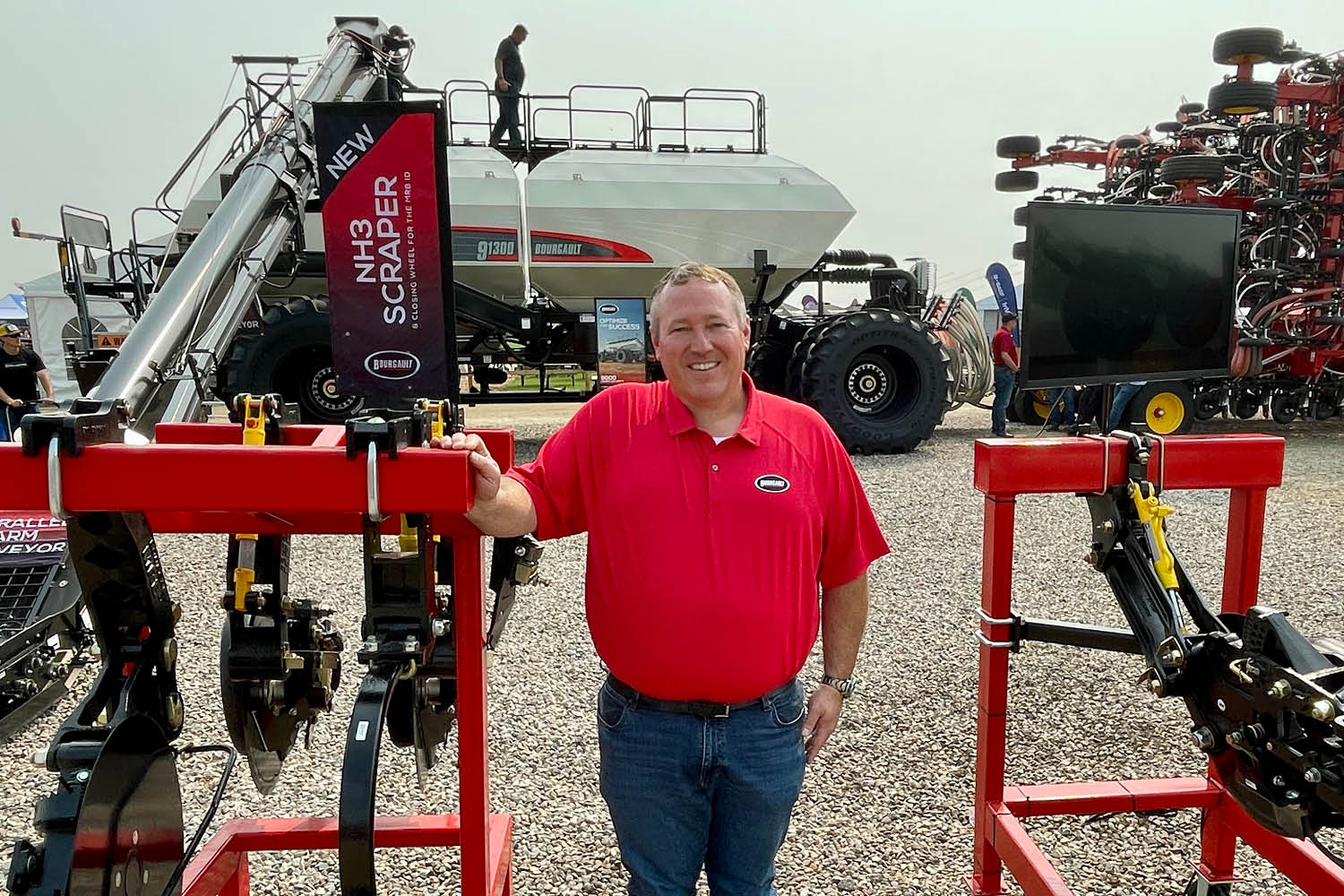
Colin Rush and the degree that defined him
Bourgault executive’s career was launched by studying mechanized agriculture at the University of Saskatchewan.
By Joanne PaulsonColin Rush landed his first job in the agricultural machinery sector before he even convocated from the University of Saskatchewan (USask) in 1998.
That passion for getting seeds into farmers’ fields continues after almost 30 years and several increasingly responsible positions. Today, he’s the Vice-President of Sales and Marketing at Bourgault Industries Ltd.
His degree from the College of Agriculture and Bioresources at USask was a Bachelor of Science in Mechanized Agriculture, a major subsequently partly absorbed into agricultural engineering for a period.
“It defined me,” Rush says. “I came off a farm that was too small to support you full-time. In that mid-90s era, there wasn’t lot of opportunity for people to go back to the farm.”
Rush followed his USask degree with an MBA in Agricultural Economics from the University of Guelph, a program that incorporated a business management diploma from Athabasca University.
Rush first worked for John Deere in marketing and dealer development. He then progressed into roles that increased in leadership at organizations that included Greenline Equipment, CNH Industrial and JCB Agriculture. He was also the president and chief operating officer at a startup company called Clean Seed Agricultural Technologies. From that time, he co-holds a patent for a component of an advanced seeding system.
He joined Bourgault just over three years ago, coming in before Bourgault’s transition to its new parent company, Linamar, and helping with the transition when the sale occurred.
“When I was first pitched the mechanized agriculture program at USask, it was this relationship between a farmer, an agronomist and an ag engineer, and I’ve spent the last almost 30 years in that space.
“I often say there are a lot of people who go to school but how many work in the field they actually studied in?” he says with a chuckle. “I’m one of the few.”
Ag equipment technology explodes
Over the years, Rush has seen the agricultural equipment industry’s technology expand dramatically. He can’t say he wasn’t warned.
“Even right out of university, I had a boss at John Deere telling us that satellites were going to drive tractors in the late 90s, and we thought, ‘that’s crazy’.”
“And here we are – it’s commonplace. In fact, people would rather stop the tractor than use their steering wheel if their GPS goes down.”
Several factors have led to this recent explosion of agricultural technology. One, of course, is simply that the world has moved that way. Farming has also responded to specific changes. For example, it’s extremely difficult to find labour.
“Thirty years ago, it was much easier to find farm workers, maybe retired farmers. Those people don’t really exist anymore,” Rush says.
Margins are tight in the ag industry and every hour saved during seeding means money on the table.
Before the technology revolution, “people didn’t really understand profit and loss, in terms of what their total costs were and how efficient they were,” he says. “Now, people are measuring downtime in minutes. They look at things like: how do I get through a wet field; how can I seed more acres per hour; how do I reduce my logistics.”
Industry connectivity
Digital integration is at the forefront of today’s ag technology. Bourgault’s electronic and digital intelligence capabilities allow their machines to integrate with other big companies’ data systems, which is important to farmers.
“If it’s not interconnected into the system where farmers can manage it and make decisions on the fly, it doesn’t get the acceptance on the market,” Rush says.
One of the latest Bourgault Intelligent Control products is an open seeding system that can essentially piggyback on other manufacturers’ systems. A farmer’s data could go through Bourgault’s cloud system or whatever data management system the producer wants, such as John Deere’s or CNH Industrial’s.
“Interconnectivity and data on the mechanization side is almost table stakes these days. Margins are so thin on our farms; (farmers are) looking for every advantage to make a decision or increase their revenue,” Rush says.
Rush notes that in the early days of connectivity development there was concern and debate about who would own all the data, but that has abated.
“The farmer owns the data.” And it has many uses.
“If you’re an owner-operator, you may have this data go directly to your accountant who is tracking the cost. It may go to an operations centre that might say, ‘oh, you’re getting low on seed and fertilizer,’ and if they have just-in-time delivery, you might have someone bring it right out to the field.”
Rush’s crystal ball tells him full automation is the next frontier. Farm equipment still requires an operator in the cab, but the new generation will truly be autonomous.
“That is pretty hard to do,” he acknowledges. “Last year there wasn’t a pothole here and now there’s a slough because it rained a lot. How do you deal with something you might have mapped out last year but still deal with real-time issues?
“We will get to fully autonomous units at some point. That’s where you pick up huge savings.”
The life of a Marketing VP
Rush’s days are not just about technology but also relationships from within the company to the far reaches of the customer base.
As Vice-President of Sales and Marketing, Rush deals with “anything that is customer facing, dealer facing, product launching and business development, such as looking at opportunities like partnerships.”
He works with Bourgault’s engineering and production departments, their agronomy research farm as well as a marketing department that manages everything from social media to pricing tools.
“Then we have our field teams which work directly with our dealers and customers across North America, Europe and elsewhere.”
Bourgault has been in Europe for almost 30 years including Kazakhstan, Ukraine, Russia, the Baltics, Romania and Moldova. The company is also in South Africa, Australia and Mongolia. Many of these countries have specific needs and regulations. For example, in the European Union, equipment must measure three metres (or 10 feet) wide, so Bourgault provides customized equipment.
“It’s a big business. North America is certainly our hub and it’s where, 52 years ago, our company started. But we haven’t just remained here.”
The personal side
Rush still owns a small farm near Saskatoon but rents out his land.
“It’s nice to be connected that way, so I can go out and walk the fields, even though I didn’t put that crop in.”
Connections to his alma mater began with his degree and they continue today.
“My wife, Lisa Scarf Rush, is a crop science major; we actually met at USask in the 90s and we’ve been married 27 years.”
Their children are following in their parents’ footsteps at USask. Their son is attending his last year of classes at the Edwards School of Business, while their daughter is studying biomedical sciences.
“(Our son) worked ag jobs, including a summer position with John Deere. Even though he started out as a business major he seems to be following the ag trajectory,” says Rush. “We definitely seem to have kept the University of Saskatchewan pedigree here, which is great.”