

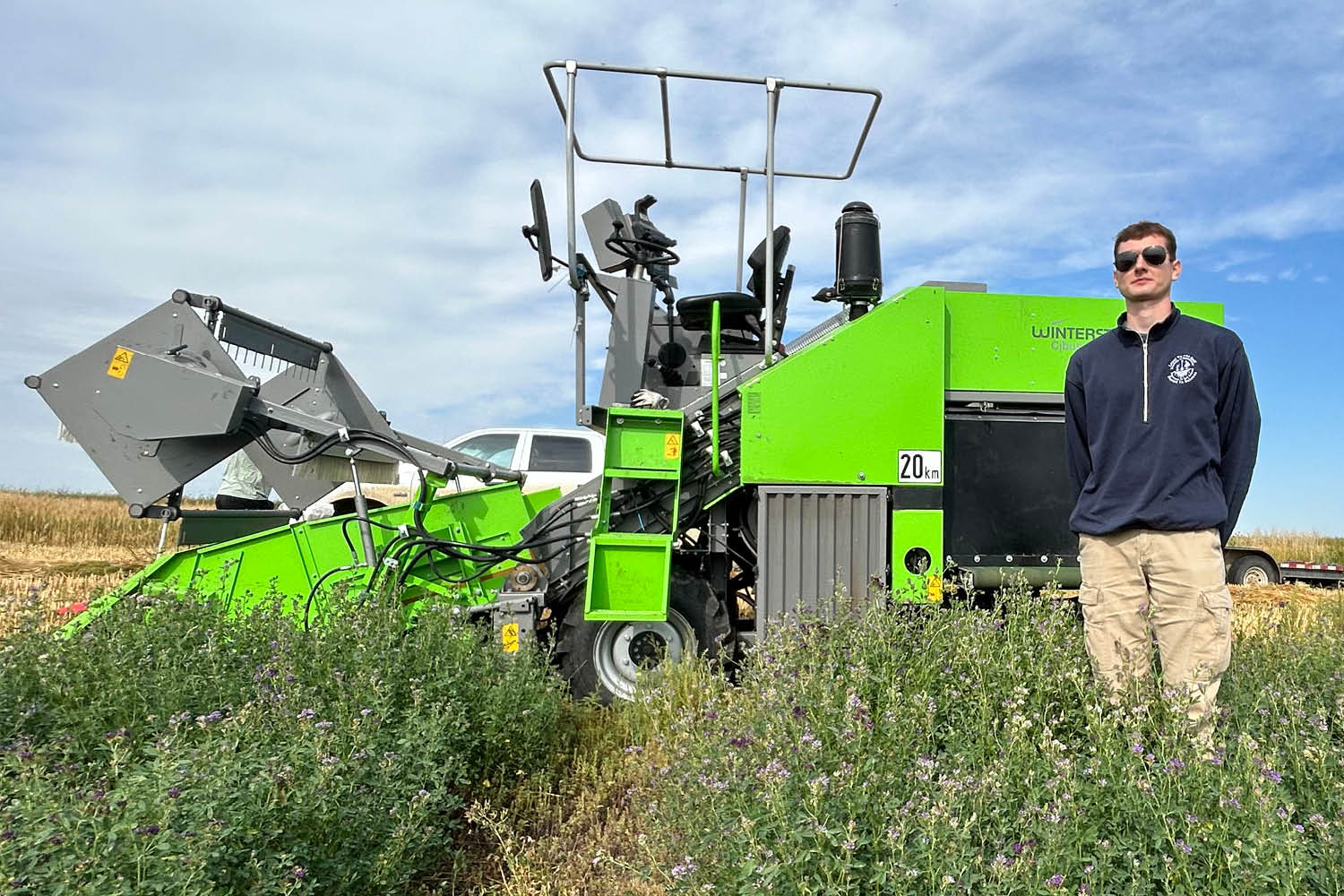
Grad student gets a once-in-a-lifetime research experience
Ty Anaka looks to better understand salinity resistance in crops using the Canadian Light Source synchrotron.
By Jane CaulfieldOne of the things Ty Anaka appreciated most about being an undergraduate student in the College of Agriculture and Bioresources (AgBio) was the number and quality of hands-on learning opportunities made available to students. It’s one of the reasons he decided to continue his education at the University of Saskatchewan (USask), enrolling in the Master in Soil Science program.
“I was able to participate in field courses, such as sampling muskegs in Northern Saskatchewan with Dr. Bryan Mood (PhD) and Métis Nation Saskatchewan,” he says. “I also had a chance to study overseas in Colchester, England, where I took coral reef biology, applied wildlife sciences and European history, gaining international perspectives and collaboration.”
Now, Anaka is a graduate student seeking to turn his real-world experience from growing up and working on his family’s multi-generational farm outside of Regina into research questions that will have global impact.
“Salty soils are found across the southern prairies,” he says. “Producers are losing more and more fertile land to soil salinity, which is concerning because crops can’t grow correctly in those conditions.”
With soil salinity rates increasing across the Prairies, Anaka says that determining how producers can successfully adapt is important.
“The cause is a bit of a perfect storm,” he says. “Groundwater in the prairies contains concentrations of salts. Changes to our precipitation patterns, caused by climate change, means the groundwater is rising which will leave these salts in the upper parts of the soil. Human environmental activity also has an impact on soil salinity.”
Growing a passion for research
Working in test plots near Central Butte and under keen supervision of soil scientist Dr. Jeff Schoenau (PhD) and plant scientist Dr. Bill Biligetu (PhD), Anaka’s research focuses on growth patterns and yields of canola and wheat produced on salty soils that have been remediated using AC Saltlander green wheatgrass.
Anaka is also working with a new USask Crop Development Centre (CDC) alfalfa variety to understand how it grows in Saskatchewan’s salty soils.
“We’re using these new varieties that have been bred by the CDC to see how well they grow in the field,” says Anaka. “We’ll be looking at yields as well as fibre and protein contents, which will be important for cattle producers and the feed they give to their cows.”
One of the most exciting opportunities for Anaka is being able to use the Canadian Light Source synchrotron (CLS) in his data collection. Using different beam lines, he has been able to examine different scopes of wavelengths to understand how the new variety of alfalfa is changing soil chemistry on a micro level and further investigate the composition of salts and other elements in affected soils.
“Being able to work with a multi-million-dollar facility like the (CLS) is scary, but it’s also pretty cool,” he says with a chuckle. “I’m going through all of my data right now and it takes a lot of coding, which is all new for me. It’s a lot of work, but really exciting.”
For Anaka, benefits like having access to the CLS, is what makes being a graduate student in AgBio truly exceptional.
“I’m learning new things every day and I am really enjoying the research process. It’s been an amazing experience so far. The cool technology that we have here in the department has been really fun to use. I don’t think you could ask for a better learning environment.”
Looking ahead to what’s next
Anaka is hopeful that he will complete his degree this year. While the goal has always been to move forward and earn a PhD, he says that he’s been thinking about taking some time off from school. He finished his undergrad in soil science and horticulture in 2025, then immediately went into the master’s program.
“I think I may head into industry to make new connections and take what I’ve learned and apply it to the real-world. Going out and meeting the people that this research applies to helps make it all worthwhile.”
For Anaka, being able to help producers adapt to changing environments is the goal.
“I’d like to keep doing research, too. Maybe I can find a job that would include a bit of both worlds so that I can better understand how to improve things for everyone. That would be great,” he says.
For now, he’s working to get the most out of his time at the university.
“I’m really happy to be doing this work at USask. I’ve learned so much, met many remarkable individuals and have been able to contribute to important research.”