

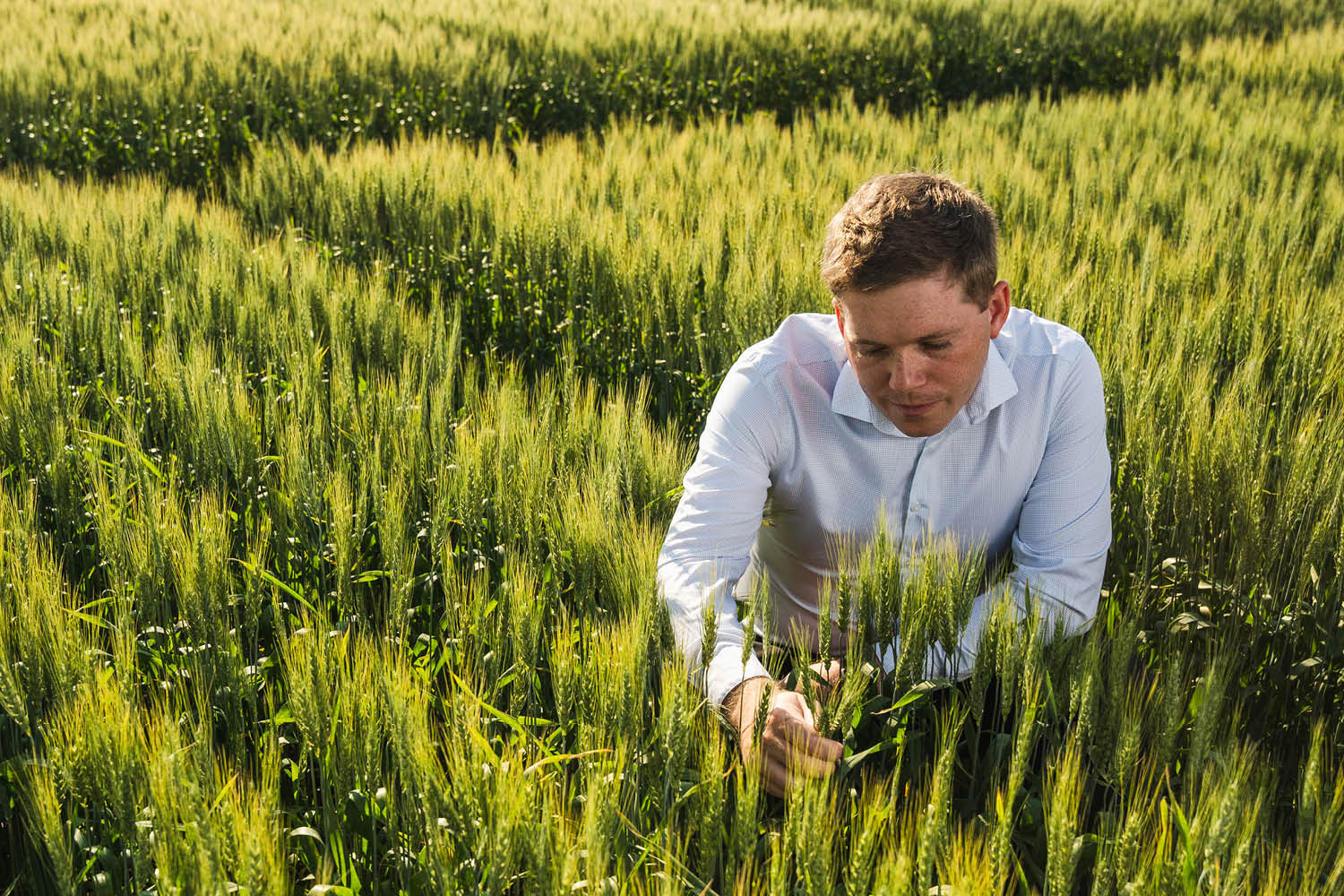
From genes to the field
How a fascination with genetics led Dr. Adam Carter (PhD) to help shape the future of Canadian wheat and canary seed crops.
By Delaney SeiferlingDr. Adam Carter (PhD) has long been fascinated by one fundamental question: Why do living things become what they are?
What determines whether a wheat plant stands tall or falls over? Why does one variety resist disease while another doesn't? How can thousands of genes interact to produce the traits farmers rely on every growing season?
That curiosity first took root in a high school biology classroom in Brandon, Man.
"I had a very charismatic biology teacher in high school, and he always emphasized the importance of genetics," he says, adding this sparked his own fascination.
"Genetics to me is what's heritable – what's passed down from generation to generation. There are hundreds to thousands of genes involved in complex processes that lead to something happening. That complexity is really interesting to me.”
Now, as the Strategic Research Program Chair in Spring Wheat and Canary Seed Breeding and Genetics at the University of Saskatchewan's (USask) Crop Development Centre (CDC), that complexity still fascinates Carter.
He’s using it to help lead one of Canada's largest and most influential public wheat breeding programs – and one of the world's only dedicated canary seed breeding programs – to breed the crops of the future.
The path to USask
Although Carter entered university knowing he wanted to study genetics, he didn't yet know where that passion would take him.
The answer arrived through a summer student position with Agriculture and Agri-Food Canada's barley breeding program in Brandon. For the first time, he saw genetics move beyond lectures and laboratories into something farmers could actually use.
"I really just loved the work of it, everything from seeding plots to maintaining them to collecting data to harvesting. Seeing plant breeding, the connection to agriculture; I just loved the whole process."
It was the moment everything clicked.
He later completed graduate studies at the University of Guelph before pursuing his PhD at the CDC under renowned wheat breeder Dr. Curtis Pozniak (PhD).
For Carter, the attraction to studying and later working at USask wasn't simply the science. He was also drawn to the CDC as a research environment where genetics, field research and practical farming challenges all came together.
“I knew that the University of Saskatchewan and the Crop Development Centre in particular was a hot spot for plant breeding and plant breeding research.”
He was also drawn to learning from Pozniak.
“Curtis is a fantastic mentor. He’s a super impressive person. He has a unique combination of skills, which make him highly effective as a scientist, but also as a leader.”
Building better wheat
The CDC’s spring wheat program has developed mainstream varieties grown on millions of acres across Western Canada.
Under previous spring wheat breeder Dr. Pierre Hucl (PhD), the program also released specialty varieties such as purple wheat. In light of this, Carter knew the expectations were high when he took over.
“Those are big shoes to fill,” he says.
Nonetheless, he is committed to carrying this work forward by concentrating on varieties that can deliver real value at scale: high yields, strong standability, improved disease resistance and the end-use quality for which Canadian wheat is known.
One of his first and top priorities has been improving resistance to Fusarium head blight, one of the Prairie's most economically damaging wheat diseases. Working collaboratively across the CDC, he helped establish a new disease nursery capable of screening tens of thousands of breeding lines each year.
Carter's PhD work helped prepare him for this challenge, exploring how emerging technologies, including drones and digital imaging, could help breeders evaluate lines more efficiently.
Today, that systems-based thinking informs how he approaches the program: not by relying on one tool, but by combining several, including field testing, data, technology and breeder judgment to make better decisions.
“No tool alone can transform plant breeding. I think it's how you can effectively use one in combination with other tools. That's true of all technologies that we're looking to apply.”
Leading a one-of-a-kind program
When Carter arrived in this role, he admits he knew little about canary seed.
Now, he is excited about the lesser-known crop, which happens to be uniquely important to our agriculture portfolio. Canada accounts for approximately 80 per cent of the world's canary seed exports, with most production occurring in Saskatchewan.
While earlier CDC breeding efforts led by Hucl aimed at developing glabrous (hairless) varieties of the seed, making the crop easier to process and handle, Carter’s focus now is on improving yields.
“Those initial glabrous varieties had a bit of a yield penalty,” he says. "That yield gap is closed within our breeding program, and now we're looking to surpass it and start to offer even higher yielding canary seed varieties to Canadian growers."
Beyond yield, he is also working to deepen the genetic understanding of the crop and support its long-term potential as a uniquely important Saskatchewan commodity. The implications of this work are wide. Because the program is unique, discoveries made in Saskatoon have the potential to influence canary seed production everywhere.
A legacy measured in generations
Carter’s career goals begin with releasing new varieties that are widely grown and genuinely useful to farmers and the broader industry.
He is also excited about the opportunity to use newer technologies to accelerate and strengthen the breeding process. Looking ahead, he believes artificial intelligence (AI), genomic prediction and phenotyping technologies will become increasingly valuable — not by replacing breeders, but by helping them make better decisions earlier in the process.
But his vision extends beyond varieties.
Working at a university gives him the opportunity to mentor graduate students who will become the next generation of plant breeders and agricultural researchers.
"Of course, at the end of my career, I want to have a long list of successful varieties that benefited farmers and the industry," he says. "Along with those varieties, I'd like to have successfully trained individuals that have successful careers of their own. That's the overall goal."
From a high school biology classroom in Brandon to one of the world's leading public plant breeding programs, Carter has spent his career trying to understand how traits are passed from one generation to the next.
Today, he's putting that understanding to work, developing the crops of the future.