

The economics of adaptation
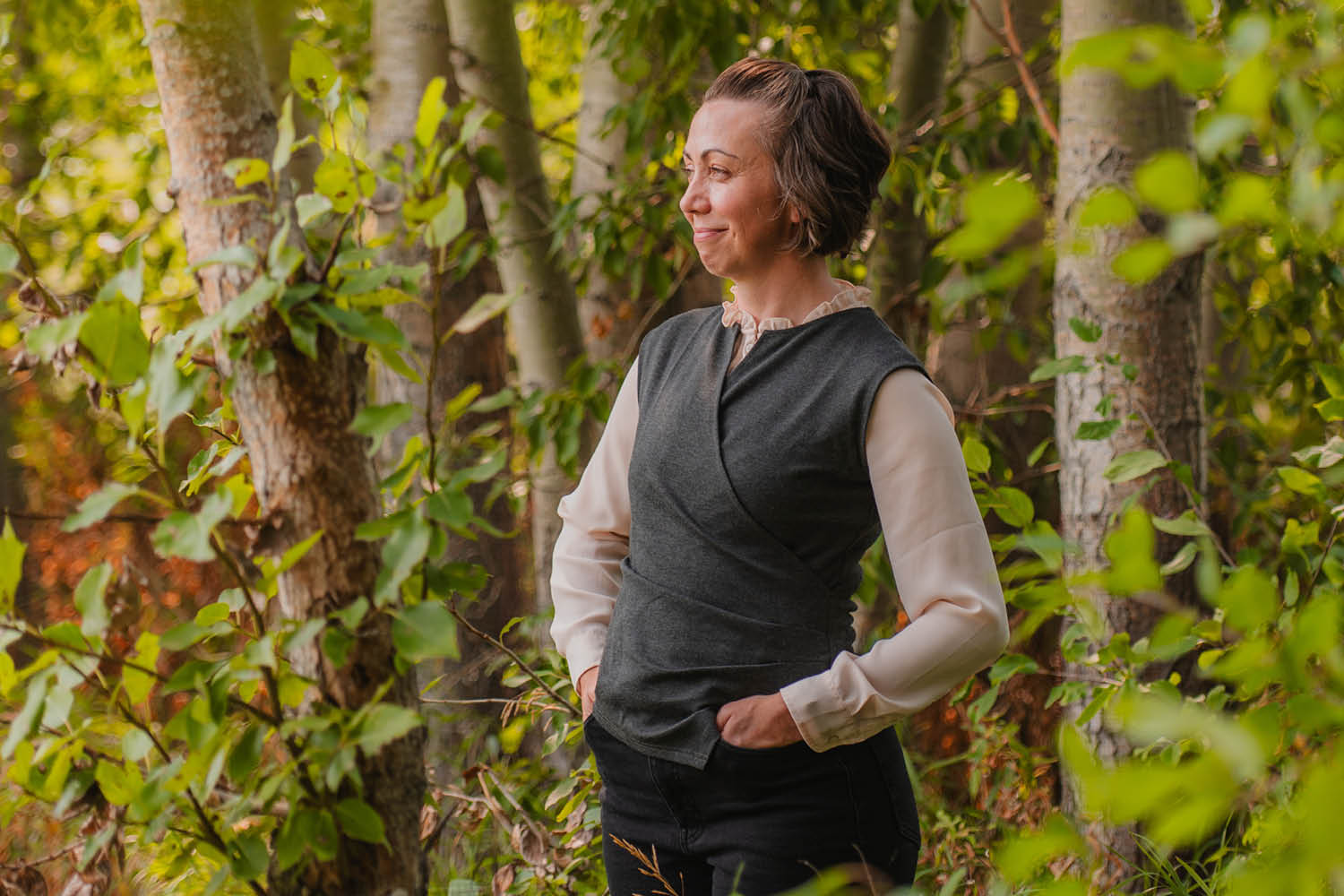
USask agricultural economist Dr. Tia McDonald (PhD) is exploring how climate, risk management and farm economics intersect – and what that means for farmers.
By Delaney SeiferlingWhen Dr. Tia McDonald (PhD) and her spouse began thinking seriously about leaving the United States (U.S.), they were looking for more than their next careers.
Both economists, they had reached a point where they were ready for a change – professionally and personally.
“We thought: Where could we live? And our first thought was Canada,” says McDonald.
Last year, she joined the University of Saskatchewan’s (USask) College of Agriculture and Bioresources as part of a cluster hire in digital agriculture and sustainability, which brings together researchers from different disciplines to collaborate on some of the biggest challenges facing agriculture.
It was exactly the kind of environment McDonald was looking for.
“That’s a pretty unique thing,” she says. “People from different departments in the college were recruited at the same time, with the hope that they work together on things. I thought that was really exciting.”
She says this spirit of collaboration is not always prominent in academia.
“I looked at the department, at all the different things that people were doing. They were working on their own stuff, but they were also working together, which is a really big draw.”
The job was also a natural fit for an economist whose career had already exposed her to different agricultural systems, institutions and policy environments across the U.S.
Today, she’s drawing on those experiences – and USask’s collaborative research environment – to explore some of the most pressing questions facing prairie producers, particularly at the intersection of climate change, farm economics and agricultural policy.
A circuitous path to agricultural economics
McDonald’s path into agricultural economics wasn’t straightforward.
After completing an undergraduate degree in political science at Colorado State University, she was on a mission to “save the world” through politics.
Then she discovered a master’s program focused on agriculture and development. Around the same time, she took a job as a research technician with the United States Department of Agriculture (USDA), an experience that would change the direction of her career.
“We were working on crop insurance at the time, and I thought, this is super interesting – which is not something people usually say about crop insurance,” she laughs.
A mentor connected her with an agricultural economics professor and things clicked. McDonald completed her master's based on the crop insurance project and went on to work in several parts of the U.S., including California and South Dakota, before completing her PhD at Purdue University in Indiana.
Along the way, she was exposed to different agricultural systems, policy environments and approaches to research. One experience that particularly influenced her was working with the USDA’s Economic Research Service.
“They really had a culture of: ‘We are here for farmers. We want to help them,’” she says. “It was very collaborative – rising tides, we’re in this together. That really shaped how I think about research.”
Climate, risk and the farm bottom line
Today, much of McDonald’s research centres on a fundamental question: How are farmers adapting (or not adapting) to a changing climate, and what role do economics and agricultural policy play in those decisions?
Part of her work examines how weather variability and climate change affect farm financial performance, which means looking beyond just yields.
“We know that for crops like corn, wheat and canola, as temperature increases, that’s kind of good for the crop – until it isn’t,” she says. “At some point, the temperature becomes damaging.”
From an economic perspective, McDonald says we might expect farmers to respond, as damaging heat days become more common, by changing crops, land use or management practices. But so far, the data suggests they aren't.
“That’s largely not true, at least not yet,” she says.
One possible explanation she is exploring is the role of crop insurance and other risk management programs. While these programs are designed to protect farmers from losses, McDonald says it is also important to understand whether their design influences incentives to adapt.
“If you have crop insurance, that’s going to make you less likely to adapt to a changing climate because you’re compensated,” she says.
Her research raises important policy questions: Can programs designed to protect farmers from short-term risk inadvertently affect longer-term adaptation? And how can those programs provide financial protection without discouraging changes that could make farms more resilient?
An emerging risk: wildfire smoke
Another area of McDonald’s research explores how wildfire smoke affects the agricultural sector, from the people doing the work to livestock and crops.
“Crop farmers are usually in well-ventilated tractors or combines, but ranchers are out there with their cattle without a lot of protection.”
The effects on livestock remain relatively under-researched, she says, despite the increasingly smoky summers experienced across Western Canada.
“This is probably an increasing trend.”
The potential impact on crops is particularly intriguing, she says.
“Anecdotally, on the crop side, the smoke can be kind of good. We had great yields last year.”
Research from outside Canada suggests smoke may diffuse solar radiation in ways that can benefit crops under some conditions although those benefits appear to diminish as smoke becomes more severe. McDonald hopes to explore those effects under Prairie growing conditions.
“The growing season here is so unique that we hope to expand that research.”
Looking beyond production
Ultimately, McDonald hopes her research can contribute to a broader conversation about how agricultural success is measured.
“One thing I’ve noticed in my brief interactions with farmers is they’re very production-oriented, which is great. But I would like to see some more profit-oriented thinking, which can help with adaptation.”
That means looking beyond whether a management decision produces the greatest possible yield and asking whether it makes economic sense for the farm over the long term.
McDonald sees an opportunity to bring more agricultural economics into research and policy discussions that have traditionally emphasized production.
“The (Saskatchewan) Ministry of Agriculture is very focused on production. In their Agriculture Development Fund (ADF) grant call, there’s nothing about profit, nothing about economics. It’s all production,” she says. “There’s such an opportunity to shift the thinking a little bit and put farmers in a better position.”
For McDonald, USask is particularly well positioned to help make that shift because economists, crop scientists, animal scientists and other researchers can tackle agricultural challenges together rather than in isolation.
“One of the strengths I see at USask that I have not seen in other universities is this intense support for each other.”
It’s a reputation, she discovered, that extends well beyond Saskatchewan.
“When I told people I was coming here, they said: ‘Oh yeah, they’re spectacular. We know them. They’re great researchers. You’re going to love it there.’”
As prairie farmers navigate changing weather, emerging risks and difficult decisions about how and when to adapt, McDonald hopes her work will encourage the sector to look beyond yield and consider how today's decisions can keep farms profitable and resilient for years to come.