

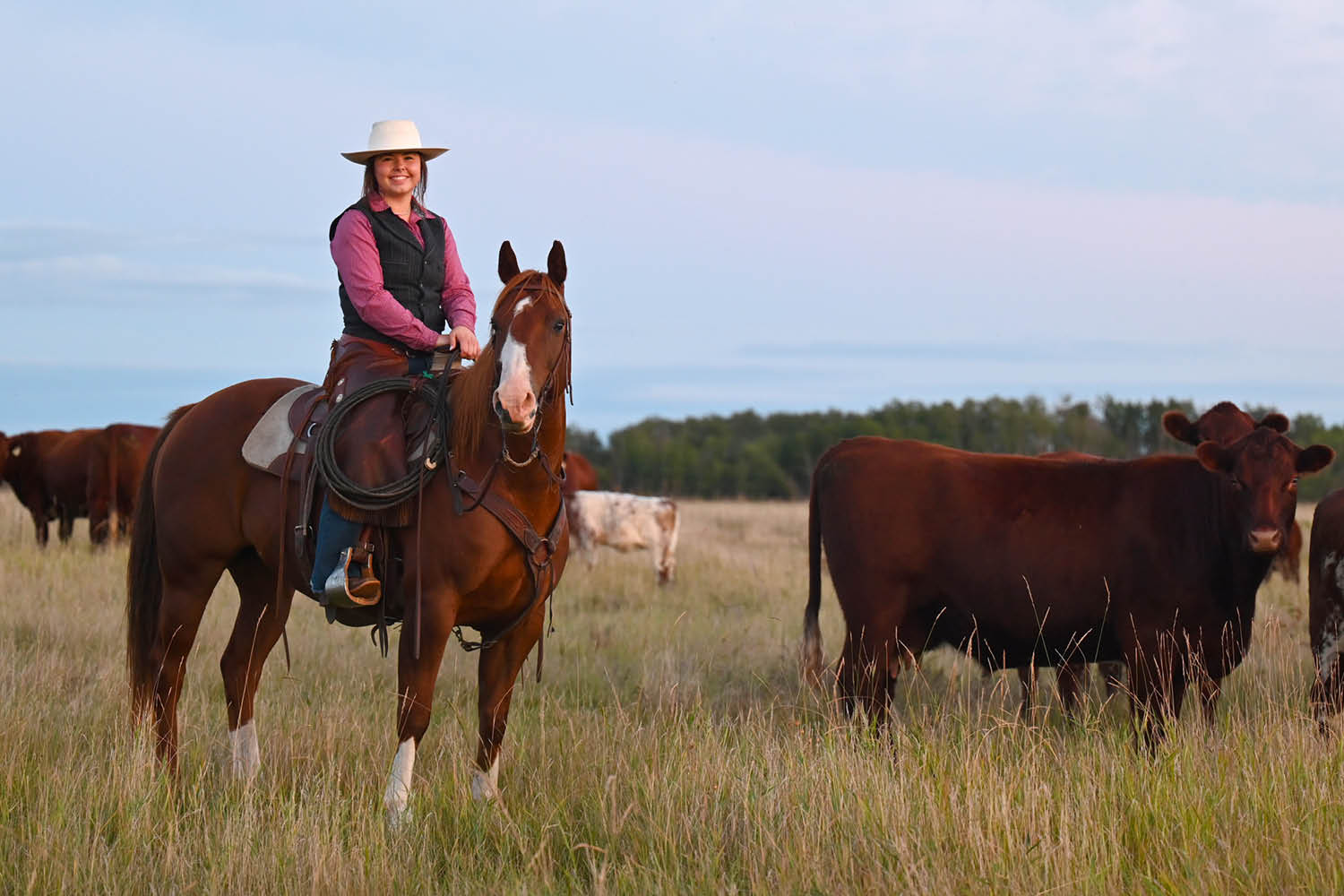
Protecting the land – and the producer – is second nature to this alumna
Morgan Lehmann has forged an exceptional path as she continues to grow her career in cow-calf production.
By Jane CaulfieldMorgan Lehmann started her undergraduate program at the University of Saskatchewan (USask) in 2019 as a student in the Bachelor of Science in Agriculture program with a focus on animal science and applied microbiology. Having grown up on a cow-calf operation near Rosthern, Sask. and being involved in the local 4-H group, she knew the program was going to be a perfect fit.
“I considered becoming a pharmacist, an accountant, a vet or a chiropractor, but I always came back to just wanting to study agriculture,” she says. “It also helped that my dad also convocated from USask with a BSA in the animal science program, and he applies what he learned in his degree every day.”
But her experience at USask would prove to be more than just textbooks and assignments. Within a few weeks of starting her first-year, Lehmann joined the USask Range Team, a student-run club focused on sustainable rangeland management. She loved it so much, she acted as co-president for three years.
“It was the best decision ever,” she says. “During introductions at the first meeting, we were asked our favorite breed of cattle or grass species and I was hooked. A highlight of Range Team was improving our plant identification skills with the help of Dr. Amanda Muller (PhD). Amanda is the faculty advisor for the team that generously spends time examining pressed specimens and guiding us on range walks at Meewasin.”
She said that one of her favourite experiences with the Range Team was attending the Society for Range Management’s annual meeting to compete in the Undergraduate Range Management Exam.
“It sounds nerdy, but we learn about grazing, nutrient cycling, invasive species management and travel to different cities in North America meeting students and range professionals from around the world.”
Now, as a graduate student and young producer, she continues to strengthen her connection to the Range Team as a coach. She’s also the treasurer of the Society for Range Management (SRM) Young Professionals Conclave and a board director with the SRM Prairie Parkland Chapter.
“I get to stay connected to rangelands locally, provincially, and globally – a unique privilege I am incredibly grateful for,” she says. “Before the Range Team, I just thought grass was grass, alfalfa was alfalfa and that rotational grazing was good. In the last seven years, I’ve found a whole world of understanding rangelands and grazing management that gave me a clearer lens and transformed how I view my own ranch management strategies. And I still have so much to learn.”
From young student to young professional
When Lehmann graduated in 2024, she had some idea of what she wanted to do next but wasn’t sure where to start. Looking to find new perspectives, she joined the Canadian Western Agribition Next Gen Ag Mentorship program, where she was paired with Scott Wright, Director of the USask Livestock and Forage Centre of Excellence. She also enrolled in the Saskatchewan Women in Ag Mentorship Program, where she was paired with Michelle Panko, a senior program advisor with the Saskatchewan Ministry of Agriculture.
“These opportunities allowed me to broaden my network while I was considering where I should go to grad school,” says Lehmann. “The advice from both Scott and Michelle was immensely important to starting my family’s succession planning and instrumental in my decision to return to the ranch after I finish my master’s.”
Now, as a grad student in the Western College of Veterinary Medicine at USask, Lehmann is looking to deepen our understanding of the relationship between cow-calf production and Canada’s changing weather patterns. More specifically, she is hoping to look at how weather impacts what and how cow-calf producers feed their cows, especially in times of drought. Her thesis supervisor is Dr. Cheryl Waldner (PhD).
“Cow-calf production in Canada is highly influenced by the weather. I know the last few years have presented unique challenges for my family’s own operation,” she says. “Understanding the differences and similarities in management decisions across herd sizes, location and type of operation allows cow-calf producers to compare their practices and explore what other operations are doing.”
Lehmann’s research also explores how drought impacts vitamin A levels, which can affect cattle’s immune and fetal development systems.
“Producers can’t control when drought starts or how long it lasts, but they can control how they prepare for and respond to drought.”
Her work in the classroom and passion for land stewardship led to her getting involved with the International Year of Rangelands and Pastoralists (IYRP), a campaign declared by the United Nations to elevate the importance of these endangered ecosystems around the world.
“When people hear the term ‘endangered ecosystems’, they may think coral reefs and rainforests, but the reality in the Prairies is there is an ecosystem at risk and rapidly disappearing all around us,” says Lehmann. “Grasslands and rangelands provide habitat, support biodiversity, cycle water and act as a carbon sink.”
She says that a campaign of this size to raise awareness for protecting rangelands and celebrating the people that steward the land is a small step forward – but one that can grow into something big if tended to with care.
“What I have seen as the most positive outcome from IYRP is simply more people out appreciating rangelands. People are not likely to fight to protect what they don’t understand. An encounter with native prairie is a chance to witness the beauty and biodiversity firsthand, and then they may be compelled to conserve the rangelands that remain.”
Turning great grief into something positive
In the fall of 2023, Lehmann’s brother Josh died by suicide, leaving a giant hole in the lives of many. It also forced her to see the industry she loves with new eyes.
“Mental health challenges affect people in the agriculture industry at alarmingly high rates. There are endless stressors in agriculture, which combined with the need to hold everything together, a culture of toughing it out and isolation during intense mental health challenges, create a perfect storm for helplessness and hopelessness.”
At the Cheyenne Frontier Days in Wyoming, Lehmann learned about an initiative aimed at promoting suicide prevention and awareness and reducing the stigma around receiving mental health supports in agriculture. She decided to bring something similar to the fields closer to home. After connecting with a couple of provincial and national organizations focused on mental health in agriculture, she launched the Josh Lehmann Memorial Roping and Pick-up Man Campaign.
“In rodeo, we call the pick-up man a lifesaver in the arena. Every cowboy knows pick-up men are out there to help and give a hand and do not hesitate to reach out. We want everyone to use that example in their lives.”
The campaign is symbolized by including a single yellow feather in your hat or on your shirt – a symbol that quietly shows others around you that you are the pick-up man and are always available for support.
“Be a pick-up man to those around you,” she says. “Sometimes it’s as simple as a text or a call. However, if you don’t feel equipped to know how to help, you can connect individuals to professional pick-up men and women who are trained to work through mental health challenges.”