

Harnessing the power of pests
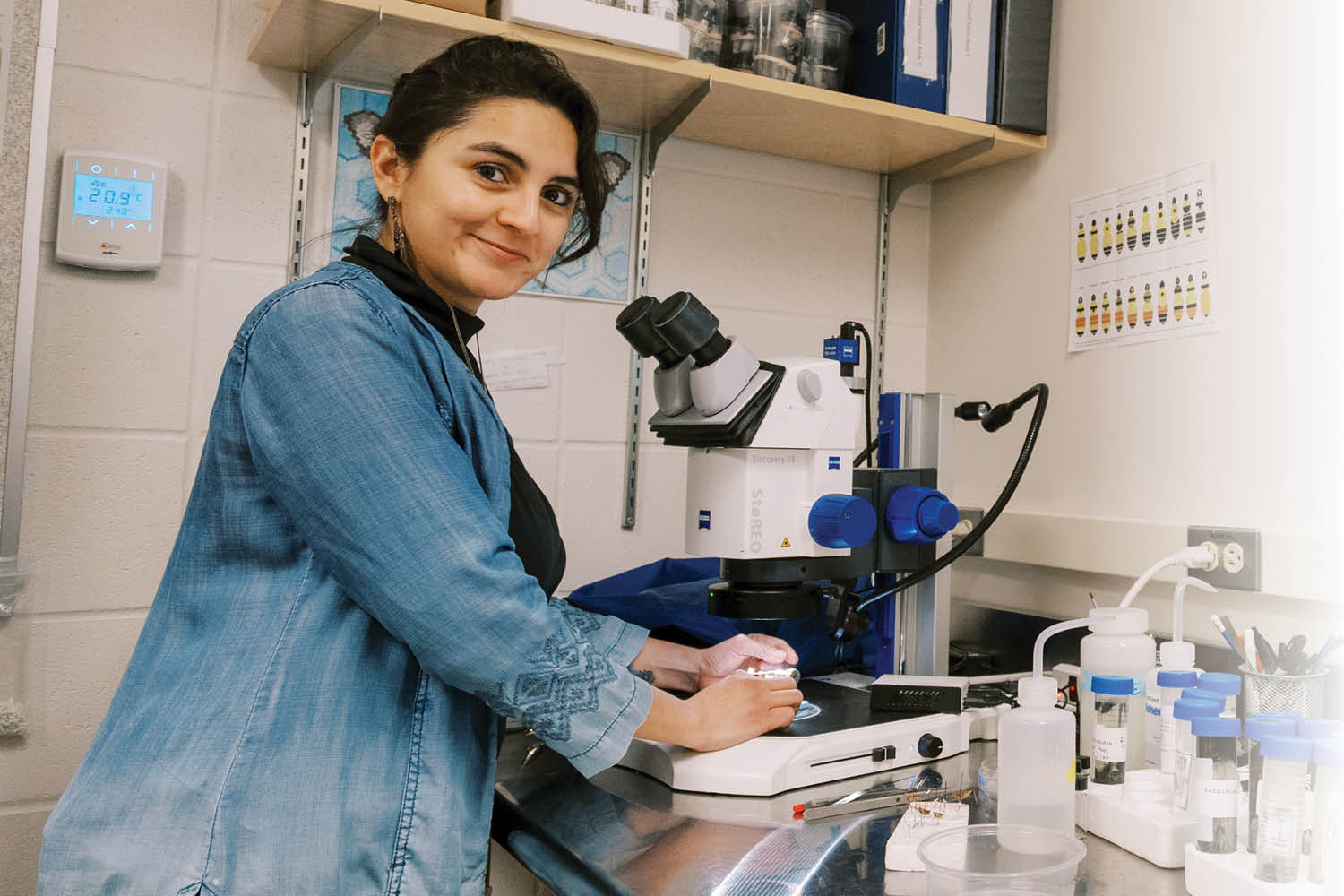
PhD student Teresa Aguiar-Cordero explores which pests, and how many, can be used to enhance pest management for producers.
By Jane CaulfieldIf the idea of fighting fire with fire can help stop the spread of an uncontrolled burn, why not look at using ‘good’ bugs to fight the ‘bad’ ones? That question is at the heart of Teresa Aguiar-Cordero’s PhD research, which explores what kind of natural enemies can help producers manage destructive insects such as lygus bugs, grasshoppers and aphids.
“I want to better understand how beneficial insects, such as ladybugs, lacewings and even some arachnids, can help producers manage their crops in a more sustainable way,” she says. “I want to understand how these interactions, between these natural enemies, can influence crop production.”
As she’s describing her research purpose, Aguiar-Cordero chuckles a little and says she recognizes the idea might seem a bit weird to some gardeners and growers.
“Some people think all bugs are bad and are quick to use pesticides, but these can be really harmful to the environment. I want to figure out how to better use what already exists in the insect world. So, for example, if I have 60 aphids on a plant, how many ladybugs do I need for effective pest management?”
She also says it’s important to understand just how these beneficial insects look for their lunch and what kind of prey they prefer.
“Ladybugs, for example, are efficient pest management for aphids because aphids are slow and ladybugs prefer easy prey. It’s about figuring out a balance.”
Aguiar-Cordero moved from Mexico a few years ago to continue her academic career at the University of Saskatchewan (USask) because she feels the College of Agriculture and Bioresources (AgBio) can provide her with opportunities to help solve some of the real-world challenges facing industry world-wide.
“There is a strong culture of academic excellence, innovation and passion for research. I have had the opportunity to work with amazing faculty, fellow students and industry partners, which has made my graduate experience both rewarding and inspiring,” she says. “What I appreciate most is how supportive the community is – people genuinely want to see each other succeed.”
Turning data collection into direct support for producers
Aguiar-Cordero’s research requires a lot of data collected from a variety of fields across the province – a feat almost too big to be done by a single grad student. But that’s a challenge she faced head on and set out to find a solution that would be helpful to producers, agronomists and researchers alike.
She co-founded Insect Track Solutions Inc. which includes a software platfrom called IPPM (Integrated Pest and Pollinator Management) Now. Her co-founders include USask alumnus Emilio Tellarini, a pollinator scientist at the Saskatchewan Beekeepers Development Commission, and fellow electrical and computer engineering graduate student Gabriel Guerra Mestanza.
IPPM Now is an artificial intelligence (AI)-powered platform designed to transform field observations into practical pest management decisions. It also focuses on beneficial insects that play essential roles in agricultural ecoysytems.
“We’re currently beta-testing a mobile app that allows producers to simply take a photo of an insect in their field,” says Aguiar-Cordero. “Within seconds, the platform identifies the insect and combines artificial intelligence with geospatial information and entomology expertise to determine whether it is a pest or a beneficial species, explain why it matters, and provide the most appropriate management or conservation recommendations.”
Rather than simply identifying insects, the platform helps users decide what action, if any, should be taken. By integrating insect identification with economic thresholds, crop information, location and current scientific knowledge, IPPM Now supports informed decisions while helping reduce unnecessary insecticide applications and protecting beneficial insects.
The app, which won the People's Choice Award at USask’s 2026 Opus Innovation Expo, is powered by AI models trained on thousands of insect images and continues to improve as more observations are collected through beta testing.
“We want to make the technology as simple and accessible as possible. We’re even gamifying the image collection process so that contributing observations is engaging while also helping improve the AI.”
The team is also developing complementary hardware called the Smart Trap, an automated monitoring device that captures images of insects on sticky cards at scheduled intervals and transmits them remotely to the platform.
“Instead of walking kilometres through a field just to check sticky cards, producers can receive the information remotely,” Aguiar-Cordero explains. “The Smart Trap and IPPM Now work together to reduce scouting time while providing timely, data-driven insights that support better pest management decisions.”
IPPM Now is currently available for beta testing through TestFlight. The team is actively seeking additional users to provide feedback and contribute observations through their website: ippmnow.com. They will continue improving the platform before its public launch, which is planned for mid-2027.
Sharing knowledge through children’s stories
When Aguiar-Cordero moved to Canada she thought a lot about how her experience was similar to that of a well-known and beneficial insect.
“I thought a lot about how I am like the honeybee, which was introduced to North America from another part of the world. I am very proud of my roots as a Mexican woman, but I am also an immigrant learning to adapt to a new environment,” she says. “But that’s what’s great about storytelling. You can connect what we know from science and people’s experiences.”
Her book, Finding Sakbe: A Children's Book About Bees, Nature, and Environmental Awareness, educates kids about bees while also helping to strengthen a foundation for a lifetime of curiosity.
“Kids are so curious about all the stuff that happens in the garden. We should help them stay curious,” she says. “Scientific information is incredibly valuable, but so are the ideas and perspective of children, of growers, of the public in general. I think that helping to establish those connections, between science and experience, can help lead to more ideas and make more brainstorming for solutions.”
State-of-the-art lab creates enhanced learning opportunities
Aguiar-Cordero’s work takes her out of a standard lab and into fields and test plots, but when she first started her graduate program she did some work in the new University of Saskatchewan’s Insect Research Facility (USIRF). As the first insect research facility with quarantine capabilities at a western Canadian university, the space supports entomological research that leads to meaningful insights about prairie ecology, boosts agriculture and reduces risk to food security.
The 500-square-foot insect quarantine facility meets Canadian Food Inspection Agency Plant Protection Containment Level-2A requirements, allowing researchers to study non-native insects and pathogens that pose a potential threat to western Canadian crops.
While her current research is on insects that are found naturally across the Canadian prairies and therefore doesn’t need quarantine facilities, she says USIRF provides valuable opportunities for students and scientists alike.
“The lab is an incredible space to work and learn in. I really like how it supports collaborative research between pest researchers and crop development.”