

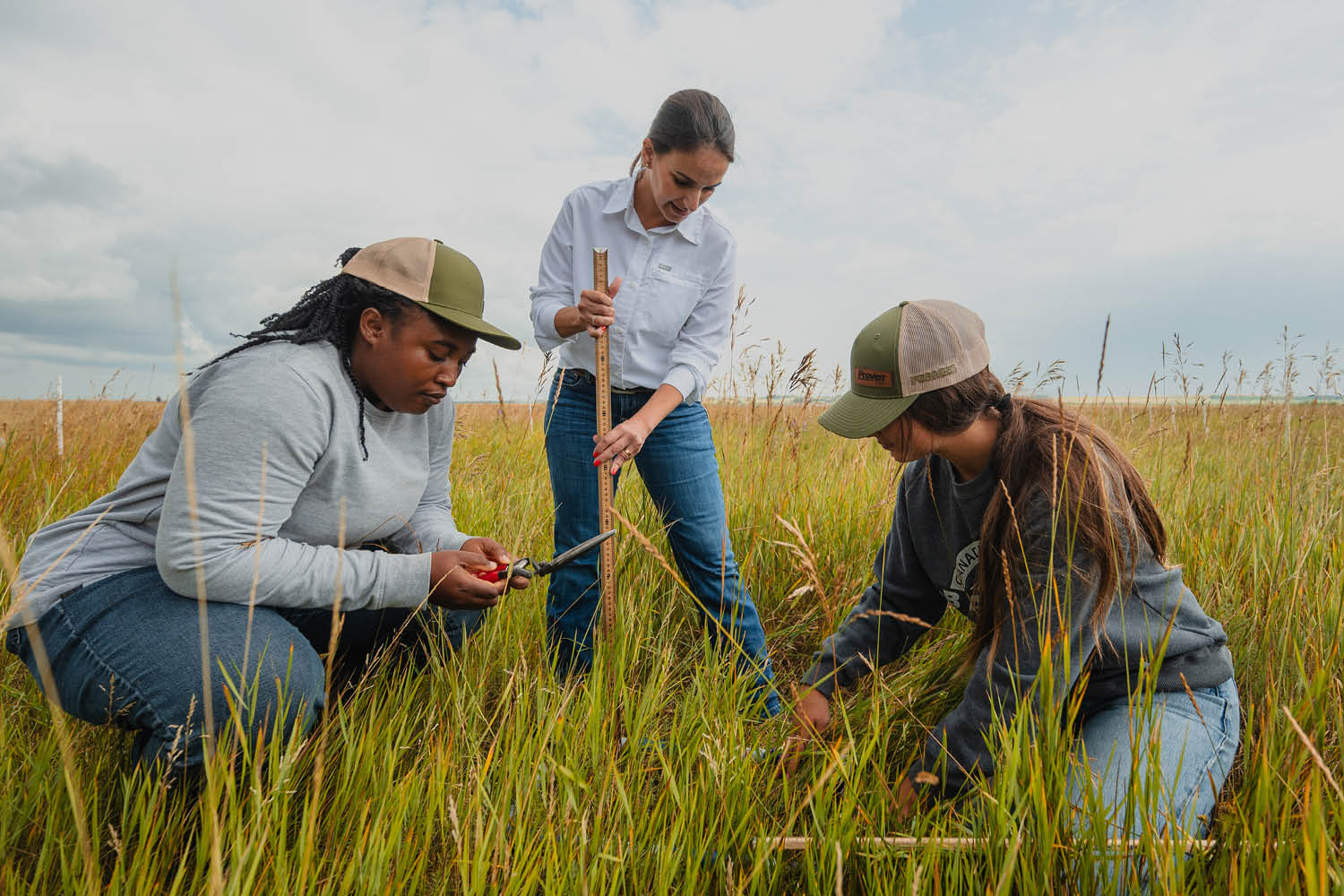
From Brazil to the Prairies: The researcher helping shape the future of Canadian beef
How Dr. Flavia van Cleef (PhD) is leaning into her international experience to help tackle one of beef production's biggest challenges: producing more while protecting the land.
By Delaney SeiferlingWhen Dr. Flavia van Cleef (PhD) first saw the University of Saskatchewan's (USask) job posting for its Beef Industry Research Chair in Integrated Forage Management and Utilization a couple of years ago, she almost didn't apply.
She was back home in Brazil after completing her PhD at the University of Florida (UF), working on a postdoctoral fellowship and caring for her newborn baby. Moving halfway around the world hardly seemed practical. But something about the position kept pulling her back.
When she travelled to Saskatoon for the interview months later, she spent several days touring research facilities, meeting future colleagues and seeing the breadth of agricultural research taking place across campus.
"I (thought), ‘Wow, this is really impressive. I need to get the job,’" she laughs.
"I got to know lots of people that I would work with in the future, and they were all so friendly, so welcoming and I felt like: ‘This is the right place to go.’"
Last spring, van Cleef and her family moved to Saskatoon. Her husband, Dr. Eric van Cleef (PhD), has since joined USask as a faculty member in the Department of Animal and Poultry Science.
"It feels like home already."
Finding her path
The journey into agricultural research wasn't the path van Cleef originally imagined. Growing up in rural communities in Brazil, she dreamed of becoming a veterinarian. Instead, someone encouraged her to enrol in an animal science university program.
As an undergraduate, she began working with sheep and cattle and quickly discovered she enjoyed asking scientific questions as much as working with the animals. Her master's research focused on silvopasture systems, where livestock, forage and trees are intentionally managed together on the same land.
"We evaluated welfare of the animals, methane emissions and grass productivity," she says.
Another important piece of the puzzle came during her PhD at UF, where she worked directly with ranchers and producers who also played a critically important role in the livestock sector.
"Florida opened my eyes to the importance of having grazing systems and also working with producers. It was where I could actually realize that I like that, too."
Just as importantly, she gained a deeper understanding that research only matters if producers can use it.
"It's not just about the research – it’s how you translate it."
That philosophy now sits at the heart of her work.
Looking at the whole picture
In her current role, van Cleef doesn’t simply study grass or cattle, she studies entire systems. Her work examines how forage species, grazing management, soil health, animal performance, water use and environmental sustainability all fit together – and how improving one part of the system can strengthen the whole.
"The great opportunity that we have here is to transform grass – something that humans don't eat – into high-quality protein," says van Cleef.
At a time when demand for high quality, sustainably produced protein is on the rise globally, she says Saskatchewan has a major opportunity.
“Most of the population will still consume meat, so we have to produce it in a way that is sustainable.”
This is especially important in a province where producers have a relatively short grazing season and every day on pasture matters.
She hopes her research will identify the forage species, grazing strategies and management practices that allow producers to extend grazing while maintaining healthy soils and productive landscapes for future generations.
"This is the magic behind livestock."
Research starts with producers
For van Cleef, one of her favourite parts of her current role is her interaction with the producers. She believes this is the most critical part of the research process: hearing from those with boots on the ground.
"One of the most important parts is this relationship; getting their feedback but also listening to their concerns."
Those conversations help identify the knowledge gaps that matter most on the farm and therefore help shape the research.
"What is most exciting for me is listening to and learning from them," she says.
Ultimately, her program aims to give producers practical guidance they can apply directly to their own operations, whether that's choosing forage species, improving grazing practices or making better use of the resources already available on their farms.
"This is the background the research will give to the field."
Why Saskatchewan matters
Thinking back to her first tour of USask, van Cleef now realizes she was right to be impressed by the university’s research capacity. In fact, her amazement has only grown. She now believes Saskatchewan offers one of the world's best living laboratories for forage and grazing research.
Its diverse soil zones, weather patterns and native prairie ecosystems create conditions unlike almost anywhere else. That diversity allows researchers to answer questions with implications far beyond Saskatchewan.
"We can try to determine whatever works best for the province, for Western Canada, for Canada nationally and then internationally."
The work matters deeply, as forage systems underpin much of Canada's beef industry. Improving how those systems function has benefits for producers, animals and the environment alike.
“It's very unique the way that we manage cattle in our lands, so it makes us unique on the map on how we can do it better."
Looking ahead
Although she is still new to USask, van Cleef already has a clear vision for the research program she hopes to build. She wants it to become known widely not only for scientific excellence, but for solving practical problems that matter to producers – in Saskatchewan and everywhere.
"My research program is trying to address all these challenges: How can we use as much as we can from the forages, but still keep it productive for years and years, so that it’s sustainable?”
Looking back, she believes every stage of her journey, from Brazil to Florida and now Saskatchewan, has prepared her for exactly that role.
"My background helps me understand how to manage this in any case. This is the beauty of it."
Fittingly, van Cleef says she will measure long-term success the same way she approaches her research: by looking at the whole system.
For her, progress won’t be defined by a single discovery, but by producing research that producers can actually use to build healthier grazing systems, stronger beef operations and a more sustainable future for Canadian agriculture.
"This is my vision for the program: To have grazing systems for the province that can support long-term productivity. This is what I mean by being sustainable."