

Better data. Better decisions.
How Dr. Bailey Peterson-Wilhelm (PhD) is helping improve the data that shapes farm management, agricultural policy and the future of Canadian agriculture.
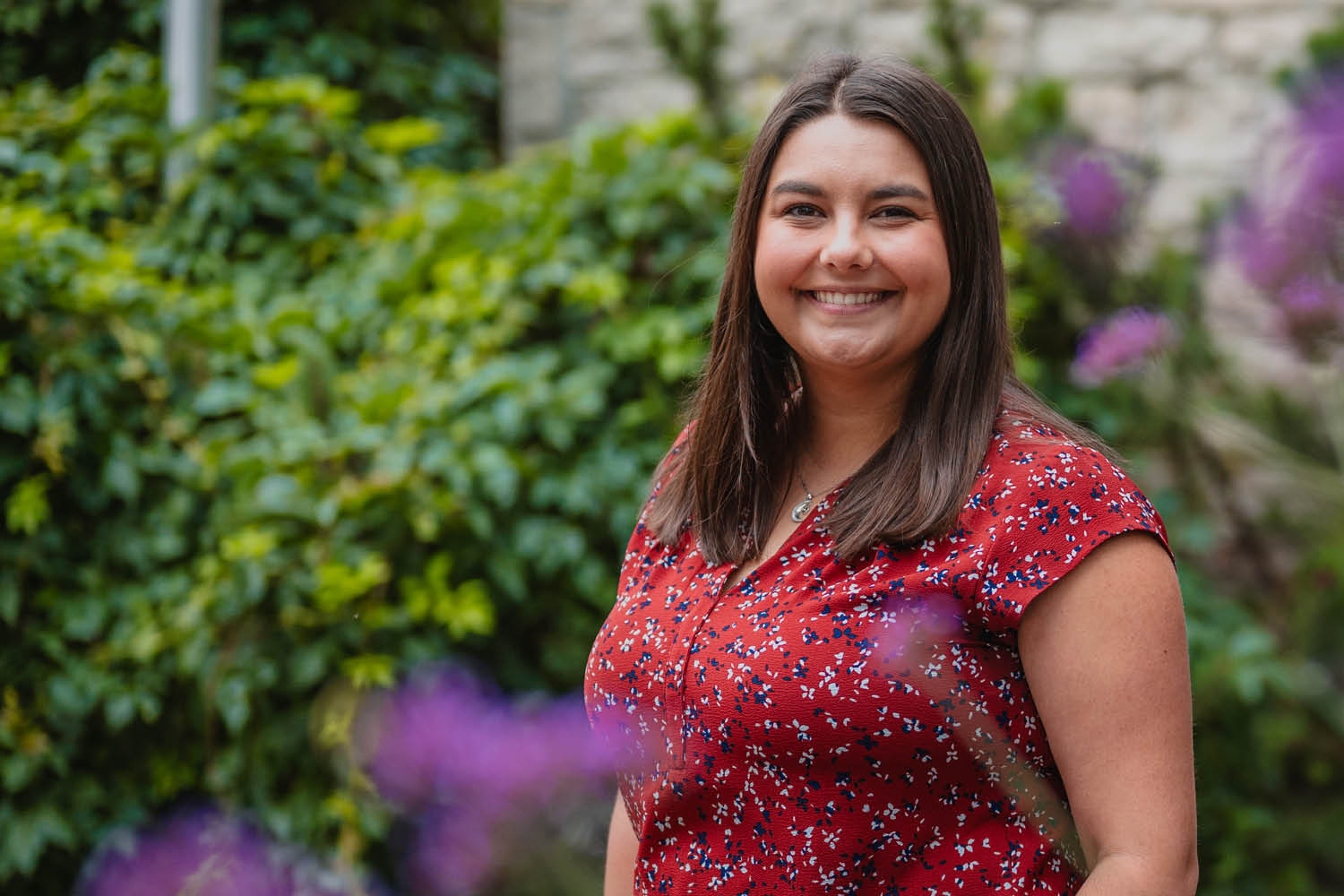
By Delaney SeiferlingDr. Bailey Peterson-Wilhelm (PhD) didn't set out to become an agricultural economist. She began university planning to become a high school agriculture teacher. Then, something unexpected happened in a first-year agricultural economics class.
"I had a blast. It was so much fun. I realized in that moment that I definitely had a passion for ag economics."
She was captivated by the way the discipline made sense of complicated systems.
"It was the way of thinking," she says. "The idea of taking a very complex system and finding some logic in it."
Today, Peterson-Wilhelm is an assistant professor in the University of Saskatchewan's (USask) College of Agriculture and Bioresources (AgBio) and is also leading research that focuses not only on interpreting agricultural data, but also on improving how that data is collected.
This is important, she says, as better information leads to better decisions.
"It's really, really hard to make an informed policy, an informed decision as a producer or as a policymaker if you don't have good data to back it up.”
From Kansas to Saskatchewan
Peterson-Wilhelm grew up in rural Kansas. Not on a farm but in a community where agriculture shaped everyday life.
"I'm a prairie kid, but a different prairie."
After discovering agricultural economics, she switched majors and went on to earn both a master's degree at the University of Arkansas and a PhD at Kansas State University in the discipline.
When she saw the posting for her current position at USask, she says the role seemed tailor-made for her.
"It was a job that had a lot of attractive components. The teaching and research aligned with my skills and interests. Then, in the interview process, the department was incredible."
Moving north to Saskatoon felt surprisingly familiar.
"I grew up in a town of 1,200," she says with a laugh. "Saskatoon is a bit bigger. In terms of the community, everyone has been fantastic. I really, really enjoy it here."
Understanding how producers make decisions
Although Peterson-Wilhelm's work centres on data, it is equally focused on people. Her research examines the human side of decision-making: how people remember information, respond to survey questions and weigh competing priorities.
"If we're relying on survey data, it's on me as the researcher to proactively ask questions in a way that’s more appropriate."
For example, in a recent project examining farm labour, researchers redesigned questions to better reflect how producers naturally think about their work.
"The simplest question would be: 'How much labour have you used in a growing season?' But that is such a big question," she says.
Instead, grain producers were asked about specific field operations and passes, while livestock producers were asked about recurring routines. By matching the question to the way people actually organize and remember their work, researchers collected more accurate data.
That matters because inaccurate data rarely affects everyone equally.
"Anytime there's this mismeasurement in data, it's often related to a characteristic of the person or outcome that is being mismeasured," she says. "If it tends to be the smaller producers that are not represented well, or have been misrepresented in data, then programs tend to disadvantage them as well."
Her research has also shown that correcting those measurement errors can significantly change how researchers evaluate agricultural programs’ effectiveness.
"If you don't account for mismeasurement, we miss the most important part of the story."
Better data, better programs
To Peterson-Wilhelm, improving agricultural data isn't simply about producing better statistics. It's about making better decisions. Agricultural surveys help shape government policy and programs, guide industry investments and provide researchers with a clearer understanding of what's happening across the sector.
Much of Peterson-Wilhelm's current research focuses on Canada's Business Risk Management programs,which provide an important financial safety net that helps producers manage risks related to weather, markets and production challenges.
Her research is exploring how producers decide whether to participate in these programs and how behavioural factors - including recent experiences, peer networks and cognitive biases - influence those decisions. The goal is to build programs that are not only evidence-based, but also more intuitive and accessible for the producers they are designed to serve.
Her work is also highly collaborative, bringing together research in economics and other areas including technology, soil science and precision agriculture with the goal of developing holistic solutions. For example, as researchers develop new technologies and production practices, economists help answer questions such as whether producers will adopt them.
"I think there's a lot of opportunities for interdisciplinary work and collaboration in areas that combine more bench science and social science perspectives.”
Helping agriculture prepare for what's next
For Peterson-Wilhelm, economics provides an important bridge between scientific discovery and real-world adoption. A new technology may improve productivity, but its impact ultimately depends on whether producers are willing and able to use it.
Peterson-Wilhelm often returns to a simple principle as a guideline for her work: what gets measured gets managed.
"I see my research as finding innovative ways to measure and manage things, so that any future policies are informed by not just the easily measured, but also the more tricky-to-measure things."
As agriculture becomes increasingly data-driven, Peterson-Wilhelm believes asking better questions may be just as important as developing new technologies.
The future of Canadian agriculture depends not only on innovation in the field, but also on ensuring the information guiding farm and policy decisions is as accurate, representative and useful as possible.
"The questions that get good answers are the questions that have good data.”