

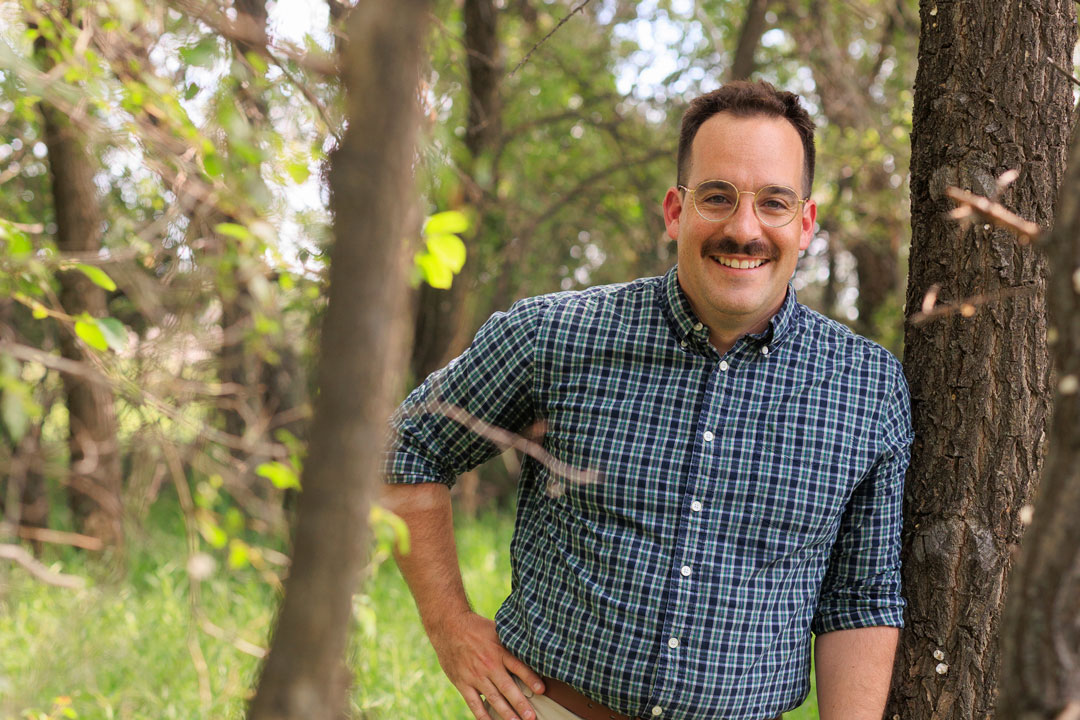
Wilderness wanderer to climate warrior
Dr. Bryan Mood’s (PhD) passion for the Earth has led him from Nova Scotia’s forests to teaching environmental science at USask.
By Joanne PaulsonAs a youngster, Dr. Bryan Mood (PhD) would frequently get lost in the wilds of southwestern Nova Scotia.
At the time, no one knew those experiences would lead to an academic career, but the foundations of his passion for environmental science were clearly built early in life.
“From that I always had an interest in forests, in wetlands, being in them and trying to understand them,” Mood said.
Today, three degrees later, Mood is a lecturer and the Renewable Resource Management Program Co-ordinator in the Department of Soil Science at the University of Saskatchewan (USask). His lifelong connection to the land has also led him to additional passions for connecting with communities, particularly Indigenous ones.
His first degree was in environmental science at Mount Allison University in Sackville, N.B. He then moved to the University of Victoria, where he earned his master’s and PhD.
“A lot of that was looking at paleoclimate and what the earth has looked like in the last 10,000 years and the last 300 years,” he said, noting that included evaluating glaciers and water resources via tree-ring reconstructions in B.C.
“What my supervisor (Dr. Dan Smith (PhD)) was really driving home was understanding the landscape and how it informs us about different things—whether it’s what the glaciers are going to do, what the trees are going to do, what the risks are to snowpacks, snowmelt, all these different variables.”
Now studying climate change, his understanding of historical weather
information is very helpful. For example: How does one know if an area is experiencing a one-in-100-year drought or flood, if you only have 30 years of record?
“That’s where paleoclimatology and these reconstructions come in. They provide additional context to resource management questions.”
Mood went on to serve as executive director of the UNESCO Southwestern Nova Biosphere Reserve Association, where he and his team developed a climate atlas—a kind of ecotourism website that still exists at climateatlas.ca.
It was at this time in his career that he learned of, and began to adopt, the concept of Two-Eyed Seeing, inspired by Elder Albert Marshall of the Eskasoni First Nation. Mood describes it as a way of viewing things through western science and traditional Indigenous ways of knowing.
That was the beginning of his vision for teaching and learning, “getting that multiple perspective on different environmental issues.”
For example, his recent research is around carbon storage. With mapping, he has identified almost 30,000 square kilometres of native aspen copses in Saskatchewan’s prairies alone.
“We’re developing regional scale growth curves to establish how much carbon is stored in them,” he said. “Some landowners like to take those out, but they offer a lot of ecosystem services.
“Those copses have a halo effect so around the rim of them we know that crop production increases 30 to 100 metres out from them.
“We’re trying to get a better understanding of this for best management practices. Obviously, they’re a nuisance, but is the nuisance worth it?”
Shelterbelts to Stantec to USask
Mood came to Saskatoon for the first time as a post-doctoral researcher in the College of Agriculture and Bioresources (AgBio) for the Agricultural Greenhouse Gas Program 2.
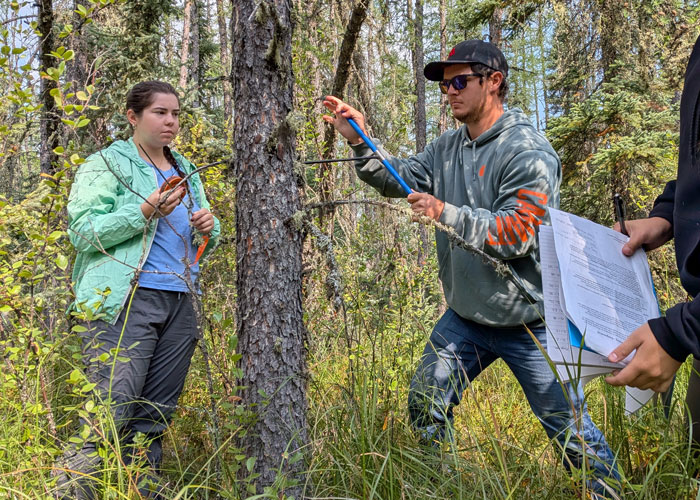
“We looked at shelterbelts, which are all over the Canadian Prairies, and we were trying to find a way, a decision support tool, to understand what their risks are associated with environmental conditions. Are they going to die because of these droughts that we’re seeing, or are they going to die in 30 years because the moisture deficits are too great, or is it temperature-related?”
The research was intended to help landowners decide which species were best to plant, and the website, shelterbelt-sk.ca, still gets about 1,000 hits per month.
His next position was with Stantec Consulting where he was part of their national Climate Risk Resilience and Sustainability team.
“I was part of the national group where any engineering project required climate risk assessments. Thinking about instead of building for the now, we’re thinking about building for the future and providing those recommendations to engineers around how to future-proof buildings and towns.”
He returned to AgBio in 2023 and took on a class that Dr. Tom Yates (PhD), now the associate dean, had taught for a decade. Yates’ expertise is in soils, with Mood’s expertise in forests. He added more forest components while continuing Yates’ tradition of working with real clients and real outcomes, along with his students.
He challenges them through “open inquiry,” getting them to think of projects and subjects that excite them, then twist them into something that makes sense with the course materials.
“My teaching pedagogy is heavily focused around Tobler’s First Law, which is that everything is connected to everything else, but near things are more connected than distant things,” he said. “That’s not just in terms of space, but also in terms of time, emotion, social structures—there are multiple ways to think about that.”
For example, one student was encouraged to write a project on food security in a class on permafrost. Permafrost affects northern airport runways, which in turn affects food security.
“We were saying, well, this airport is located in a very vulnerable location. It obviously will be affected by climate change permafrost degradation. No food, no medical evacuation, no anything like that.”
Indigenizing the curriculum
The permafrost project serves as an example of his focus on Indigenizing his teaching.
“One of the big things I wanted to do when I came to the University of Saskatchewan was really Indigenize the resource management curriculum. Tom had been doing a wonderful job of that,” he said.
Mood is applying the Two-Eyed Seeing principle in all his curricula, such as his forest ecology class, which carries themes of reconciliation and reciprocity.
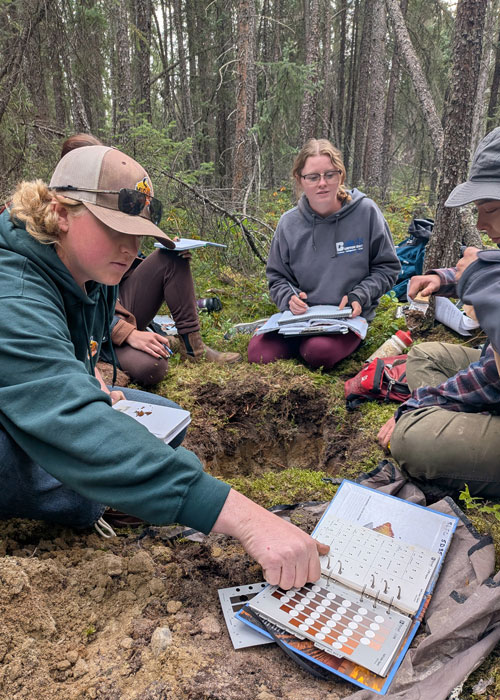
“I do a plant identification and soil identification class as well, and as part of reconciliation, I’ve included the Cree names of the plants we look at and their traditional uses as well. We focus on Cree for names so all the names we would provide, along with the medicinal, technological and food uses.”
By the end of that class, students began to grasp that a lot of species often thought about in silos, such as birch or alder, have similar medicinal characteristics and grow in the same environments.
“They’re all part of the willow family so they have acetylsalicylic acid, which is aspirin, basically.”
With senior undergrads, Mood is also running an applied environmental project with the Little Pine First Nation, the first part of a 10-year project on food sovereignty, with the support of the college’s kichiokāmīmāw askiy (Great Mother Earth) Knowledge Centre.
The First Nation is in a food desert, Mood describes, with the closest grocery store 70 kilometres away. His group is evaluating how the community can grow its own food, including fresh vegetables and livestock.
“We don’t want to helicopter in and leave. We want to do as much as we can in the community,” he said. “That project, and class, itself is an act of reconciliation and providing information they want.”
They also visit schools in the area and work with Grades 10 to 12 students on their projects.
“My dream is that I have a student in five years’ time that came from one of these schools that we visit and have this full-circle reciprocity.”