

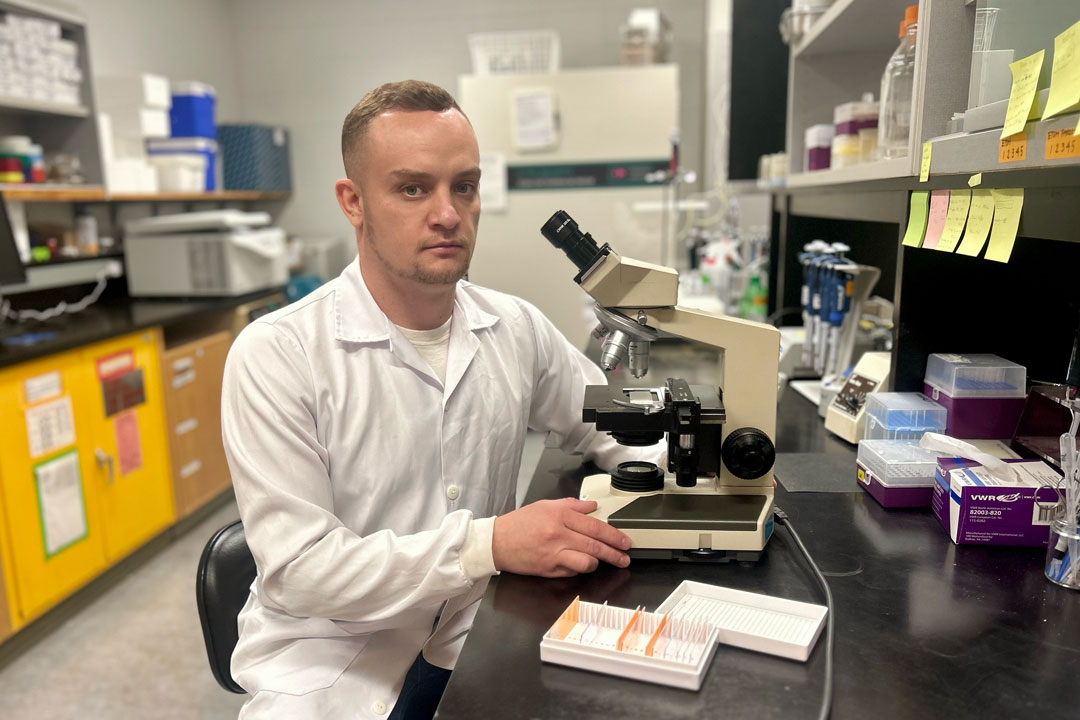
Building better lentil varieties at USask
USask PhD student Alex Silvestrini explores ways to build more resilient lentil varieties.
By Ian GoodwillieCanada’s agricultural landscape is vast. Across the country, there are seemingly endless crops being grown in fields, orchards and beyond. Shimmering fields of wheat rocking in the breeze or vast ranges of canola that seem to glow in the sunlight are often among the first that come to mind.
Still, those are not the only stars of the Canadian agricultural show.
Lentils are now one of the country’s most significant crops, where Canada has become a world leader in their production to the tune of $4.2 billion per year. However, this scale of success doesn’t come without concerns.
Varieties grown in Canada can be vulnerable to several stressors due to limited genetic diversity. That’s where research at places like the University of Saskatchewan’s (USask) College of Agriculture and Bioresources comes in, diversifying those varieties and strengthening the world’s food supply.
Running back to Saskatoon
Originally from Lavras, Brazil, Silvestrini moved to Canada to pursue a PhD in Plant Sciences at USask. He was raised on a coffee farm that has been in his family for five generations, something that spurred his interest in studying agriculture on a deeper level.
Some might ask how a man who grew coffee in Brazil ended up researching lentils in Canada. According to Silvestrini, it makes perfect sense.
“I chose this project first due to my extensive background in plant genetics and the lack of genomics resources available for lentils, to which I consider I could contribute,” he said.
Silvestrini holds a Bachelor of Science in Agronomy and a master’s in genetics and plant breeding from the Federal University of Lavras, Brazil. Combine that with his passion for agriculture and it’s easy to see that Silvestrini is the right person for the job.
Leading the charge
Under the supervision of Dr. Kirstin Bett (PhD), Silvestrini’s PhD work focuses on ways to build more resilient lentil varieties for the agricultural sector to grow and harvest. His research is part of a Genome Canada-funded project called Enhancing the Value of Lentil Variation for Ecosystem Survival (EVOLVES).
His specific contributions are in genome analysis. Part of that is comparing the genomes of the cultivated lentil and its six wild relatives in an effort to understand their differences and how they could work in combination for crop improvement.
The problem comes in the cross-breeding efforts, Silvestrini explained.
“One of the main issues that arises when trying to cross different lentils is related to chromosomal compatibility among them, first due to crossing different species and second due to the structural differences in their chromosomes, making the plant breeding process difficult.”
To that end, he is trying to figure out why the chromosomes of these seven lentil species are less compatible and how to mitigate the issues when attempting crossbreeding.
The why of it all
If this seems like a massive undertaking, you’d be right, but his work is important to both lentil production and worldwide food stability. Silvestrini’s research will play a huge role in helping plant breeders make informed decisions in developing new varieties. That could be a game-changer.
When asked about the impact of his research, Silvestrini said, “This will enhance crop resilience and productivity, leading to economic benefits for farmers and the broader agricultural sector. Beyond its practical applications, my results also advance fundamental scientific knowledge by offering new insights into genome evolution in plants.”
And there has been progress.
“The scientific approaches used in my research are relatively new and unique within the Department of Plant Sciences and in the field of lentil genomics,” he said. “The main outcome of this work will be a scientific manuscript presenting the first genome assemblies for all seven lentil species—something already available for many other crops, but not yet for lentils.”
A team effort
There’s no doubt that years of education and research are paying off for Silvestrini. At the same time, he’s the first to acknowledge this is a massive team effort from around the world.
Of course, he continues to work with the EVOLVES project. On top of that, he has several collaborators in Saskatoon at USask and the National Research Council. These efforts also stretch beyond borders into the United States, Europe, and Australia.
The Czech Republic, a well-known hub for plant genetics research, played a key role in his specific research. Silvestrini spent two months at the Czech Academy of Sciences working in the lab of Dr. Jiri Macas (PhD).
This trip, which was supported by the Robert B. and Norma McKercher Graduate Award for International Studies, led to a breakthrough discovery, “… identifying chromosomal regions, particularly centromeres, associated with major chromosome changes in lentils.”
Research like this wouldn’t be possible without funding sources. Silvestrini’s work was generously supported by the EVOLVES project funded by Genome Canada and managed by Genome Prairie.
Additionally, he received matching funding from the Saskatchewan Pulse Growers, the Western Grains Research Foundation, the Saskatchewan Ministry of Agriculture, and USask.
The future is bright
Silvestrini defended his PhD dissertation at the end of summer 2025. He intends to continue walking the research path and focus on genetics and genomics. There is certainly more to do in this field.
“Now that we have a better understanding of chromosomal changes across the different Lens species, the next step is to investigate what happens within each species,” he said.
Silvestrini’s work has developed tools and generated data that will assist in deeper tracking of issues present when planning crosses between lentil species. His goal is to bring greater stability to agricultural practices and improved food security for the world.