


Cultivating global connections
Dr. Karen Tanino (PhD) is growing more than just resilient plants—she’s cultivating global partnerships that are transforming agricultural research and education.
By Michelle BoultonA career rooted in resilience
Tanino is a professor of abiotic stress physiology in the Department of Plant Sciences in the College of Agriculture and Bioresources at the University of Saskatchewan (USask). Her international collaborations and commitment to creating international opportunities for her students recently earned her the 2025 J. W. George Ivany Internationalization Award for Faculty. It’s well-deserved recognition for someone whose career is defined by crossing scientific, geographic and cultural boundaries to improve global agriculture and student learning.
Tanino’s research examines how plants can improve their resistance to multiple abiotic stresses, including low and high temperature, drought, salt concentrations in soil, as well as biotic stress, like diseases. With these interests in mind, it’s no wonder she was drawn to Saskatchewan even before completing her PhD at Oregon State University.
“To a person who studies low temperature stress, the −40°C winters were oddly appealing,” she said, with a laugh.
Her research is focused on trying to find what she calls “the sweet spot,” a common mechanism that allows plants to resist multiple abiotic and biotic stresses.
“In the lab, we usually only impose one stress at a time,” she explained, “but in the field, plants are exposed to multiple stresses. What we do in the lab often does not translate into the field.”
She is working on a project in which her team constructed 12 high tunnels in the horticulture field plots, where she says they have the best of both worlds. They’re growing plants under field conditions and controlling the environment by imposing various stresses at critical stages of development.
Tanino works with a range of plants, from fruits, vegetables, and trees to large field crops like wheat and canola.
“The resilience mechanisms that apply to agronomy and large-scale crops can often be applied to horticultural crops,” she said. “The difference is that horticulture crops are high value on small acres. I think our horticulture degree students are attracted to that because you don’t need multiple millions of dollars to buy equipment and land.”
USask is one of the few places in Canada that still offers a horticulture science degree. However, Tanino says students on the Prairies don’t always see the full potential of their degree, so she looks for opportunities to show them what horticulture looks like elsewhere.
“We don’t necessarily have to do international travel," she said. “I have taken students to Ontario and Western Canada, places where horticulture really means something.”
Creating global connections
Beyond her research at USask, Tanino holds adjunct professorships at Iwate University in Japan and the University of Agricultural Sciences (GKVK) in Bangalore, India, and leads the Northern Food Security Thematic Network for the University of the Arctic. She also maintains ties with Tamil Nadu Agricultural University (TNAU), in India. Her global network is a reflection of her core belief in international collaboration.
Among these many global connections, USask’s partnership with Iwate University stands out. Iwate is part of a consortium of four universities called the United Graduate School of Agricultural Sciences (UGAS). In the early 2000s, Iwate reached out to USask, and the two universities signed their first agreement in 2008. Since then, dozens of PhD students and several faculty members from Japan have visited USask
This led to a number of other agreements, including a dual PhD in plant sciences.
“That’s where students write one thesis and receive two PhD degrees—one from each institution,” said Tanino. “We were the first university in the world to have this with Japan.”
Travel as a transformative student experience
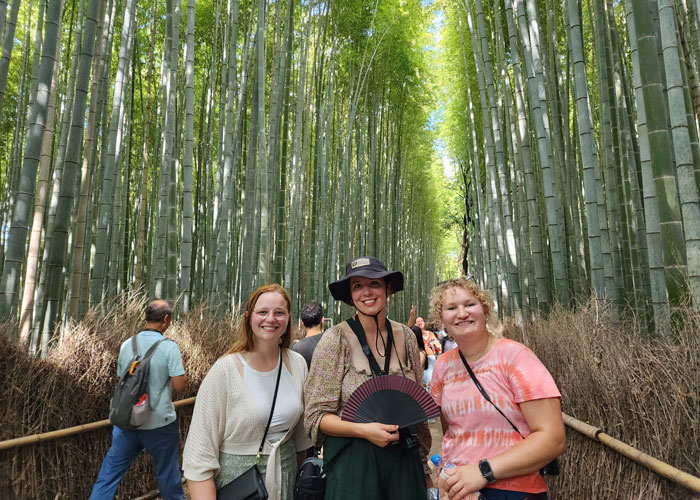
One of the most impactful aspects of Tanino’s teaching is her International Study Tour (AGRC 311.3), where she takes students to countries like the Netherlands and Japan. Far from being a sightseeing trip, the course is academically rigorous and structured to maximize learning.
Before departure, each student researches and writes a draft paper on one of the 20+ sites they’ll visit during the two-week trip. These may include places like research stations, farms, and cultural sites. At each location, students take extensive notes, and on the final day, they write a two-hour open book final exam about the sites they’ve visited.
Students also attend an international conference during the trip, where they are expected to interview four presenters and write reflections on how they could apply what they’ve learned back in Canada.
“I like to bring students to international conferences,” said Tanino. “They come back excited; they can see how their own research could be applied and valuable.”
When they return, students complete their term paper, highlighting what they learned that they could not have found in journals and books, and present their paper to junior students. They’re evaluated on their final exam, their term paper, their conference assignment, and their oral presentation.
“It’s intense,” she said, “but students have told me it’s also life changing.”
As a third-generation Japanese-Canadian, Tanino especially values showing students modern agricultural practices and the cultural roots that connect her to Japan.
Global connections lead to innovation
In addition to her other international affiliations, Tanino helped to facilitate an exchange program with the Norwegian University of Agricultural Sciences in which more than 30 faculty and graduate students participated, and also developed a one-on-one student exchange program with Haas University in the Netherlands.
She frequently hosts visiting students from around the world (Australia, Colombia, Norway, China, Thailand) in her home.
Tanino co-advises international dual PhD students and promotes collaborative research.
“You look at the top papers in the top journals, they’re not single-author and, most often, they’re from multiple countries,” she said.
She believes that building a more connected world will power discovery, broaden student and faculty perspectives, and train the kind of innovative thinkers the world needs.