

Growth and strength
A PhD student, teaching assistant, and competitive weightlifter, Laura Carruthers (BSA’22) balances the heavy demands of graduate research and international competition
By SEAN CONROYThe Green&White caught up with Laura Carruthers, a University of Saskatchewan (USask) College of Agriculture and Bioresources (AgBio) alumna, whose work aims to reduce greenhouse gas emissions and whose rigorous training keeps her on track to represent Canada in her sport of competitive weightlifting.
You majored in crop science as an undergrad. Why did you gravitate toward this area of AgBio?
I chose crop science because I was initially interested in plant breeding, but through courses I uncovered my passion for horticultural crops and sustainable management practices. I also spent a summer during undergrad working in the Okanagan Valley doing export fruit agronomy, which furthered my interest in horticultural crops.
Tell us about your current PhD research. What impact are you hoping it has?
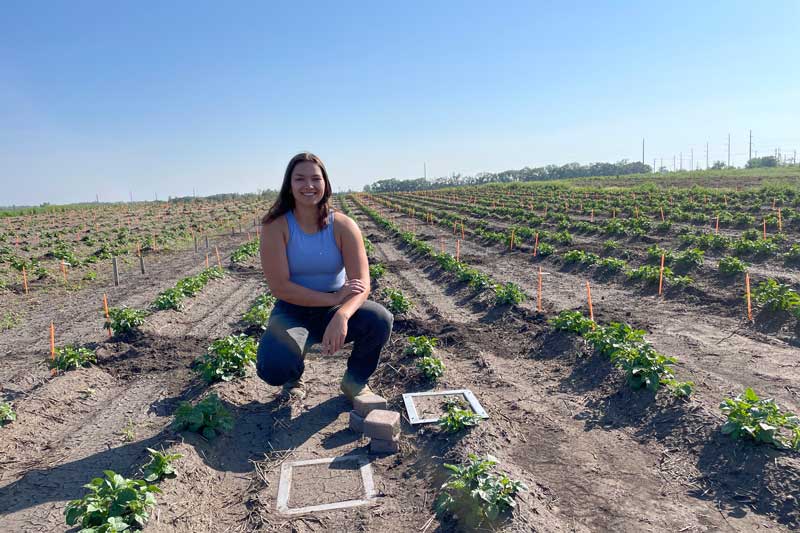
I am nearing the end of my PhD journey, just completing the final edits of my thesis and hoping to defend in the spring. My research identified cultivar-based differences in potato nitrogen and phosphorus use efficiency; I hope the improved efficiency cultivars I identified can be recommended to producers so fertilizer rates and fertilizer losses can be reduced.
My work also explored nitrous oxide emission dynamics from horticultural systems, including impact of fertilizer, soil, and management factors. I hope this work highlights how management factors beyond 4R nutrient stewardship—the right source of fertilizer used at the right rate, at the right time, and in the right place—can be used to manage nitrous oxide emissions.
Additionally, I hope it uncovers how important it is to consider past management history of a site as that can influence factors that determine emissions potential.
What inspired you to pursue this area of study?
I was inspired to pursue what started as a project on potato nutrient use efficiency because of my passion for horticultural crops. After starting my MSc, I had the opportunity to transfer to the PhD program, and I expanded my research to include more nitrous oxide dynamics.
I wanted to do nitrous oxide research because it is a potent greenhouse gas and finding ways to reduce emissions from agricultural systems will only become more important in the face of a changing climate and increased food demand. Finding diverse strategies to improve nitrogen cycling and reducing emissions is work I hope to continue throughout my career.
You have received several USask scholarships and awards through your studies as an undergrad and grad student. Most recently, you received the Plant Science Department Recruitment Scholarship. You have also received many donor-funded scholarships including the Daniel Geddes Graduate Scholarship in Plant Sciences and the Dr. Robert E. Redmann Memorial Scholarship in Plant Sciences, to name a couple. What does this type of support mean to you?
I am really grateful for the funding and scholarships available for AgBio graduate students. This support has allowed me to balance research, teaching, and weightlifting without having to take on additional work. Travelling for weightlifting is not cheap, and I am very grateful for the funding and scholarships that have allowed me to pursue high-level sport in addition to my research.
How did you get started in competitive weightlifting? What do you love about the sport?
I got into weightlifting after doing CrossFit for a few years, which involves Olympic-style lifts. I started training and competing more seriously in spring of 2022, around the same time as I started grad school.
I love the sport because it is easy to see your progress over time and appreciate how far you have come from when you started. My favourite parts are getting to train with my friends, travel/compete, and meet new people.
What does your training consist of? How do you manage the dedication required for both your research and your sport?
I train four times per week, with each session taking about two hours. I also add CrossFit once or twice a week for overall conditioning. Training consists of variations of each of the main lifts—snatch, clean, and jerk—along with different squat variations and accessory work.
The hardest part of balancing research and weightlifting is probably when major school deadlines overlap with weightlifting competitions, mostly because I have to fight the urge to stress-eat junk food in order to make my weight class for competition.
I usually coach CrossFit and get my weightlifting sessions done early in the morning so I can have the rest of the day for my research and teaching. It can be a lot of commitments to balance, but I like to stay busy and find the most efficient ways of doing things!
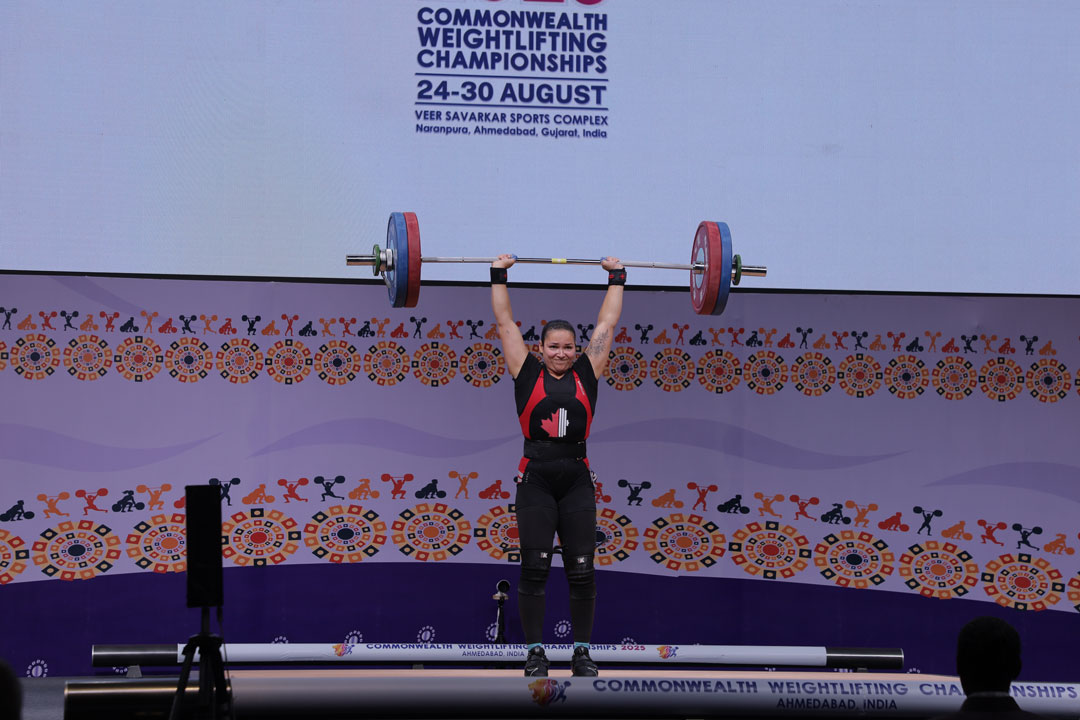
How was your experience representing Canada at the 2025 Commonwealth Weightlifting Championships in India?
I lifted in the 77 kg women’s category and placed ninth. This was my first time representing Team Canada and it was an incredible experience getting to compete on an international stage and experience a new country and culture! When I started weightlifting in 2022, the thought of competing internationally seemed far-fetched, so being selected to an international team, especially while still in graduate school, is something I am proud of.
What's next for you in both your PhD program and weightlifting competitions?
Heading into 2026 I am looking forward to wrapping up and defending my thesis and hopefully finding a job! Through grad school I uncovered my passion and skillset for teaching and science communication, so I am hoping to find work that allows me to utilize those skills.
For weightlifting, I will ramp up training in the spring leading into my fourth national competition. I also recently had my best competition to date at the Western Canadian Championships with a 92 kg snatch and 114 kg clean and jerk, hitting the qualification marker for 2026 Senior Pan-American Championships in Venezuela, so I am hoping to be selected for that team.