

Changing the future of food
USask’s Department of Food and Bioproduct Sciences taps into the potential of fermentation, protein extraction, and ingredient development.
By Delaney SeiferlingDr. Darren Korber (PhD) knows that the University of Saskatchewan's (USask) Department of Food and Bioproduct Sciences is not as well-known as some of the larger departments in the College of Agriculture and Bioresources.
But the department punches above its weight in terms of, amongst other things, the importance of its ongoing research.
Powered in part by the capabilities of its recently revamped fermentation pilot plant, researchers in the department are addressing some of today’s most important global issues, including food security and sustainable resource use, while also exploiting Saskatchewan’s natural resources to deliver innovative and valuable new products that will boost our economy and address global issues.
“When it comes to agriculture, most people think farmgate—soil science, plant science, crop development, animal science,” said Korber, who has been head of the department for six and a half years.
“We are the less-known entity in agriculture. But we have a lot of really, really good things going on in our department, in so many different areas,” he said.
The discipline of food and bioproduct science—which combines biology, chemistry, microbiology, engineering, and nutritional knowledge to understand and improve how we transform raw agricultural materials into safe, nutritious and sustainable products—has perhaps never been more important.
And Saskatchewan is uniquely positioned to deliver these solutions. Rich in agricultural production in general, it is also a global leader in growing nutrient- and protein-dense pulse crops, which represent significant untapped potential in terms of advanced protein extraction, fermentation and novel ingredient development.
Saskatchewan is also home to scientific institutions such as USask, that are leading the way in terms of innovation and academic expertise in this area.
The Department of Food and Bioproduct Sciences is a prime example of this, as exemplified by some of its ongoing research.
For example, Dr. Mike Nickerson (PhD) has developed a pulse-based microcapsule, designed to improve the absorption of probiotics and prebiotics in humans and animals, while Dr. Haixia Zhang (PhD), a recent new hire, is developing vegan meat alternatives using fermented mushroom mycelia as a base. Dr. Xiao Qiu (PhD) is working on ways to get plants and microbes to naturally produce healthy omega-3 fats, important for brain health, heart function and overall growth.
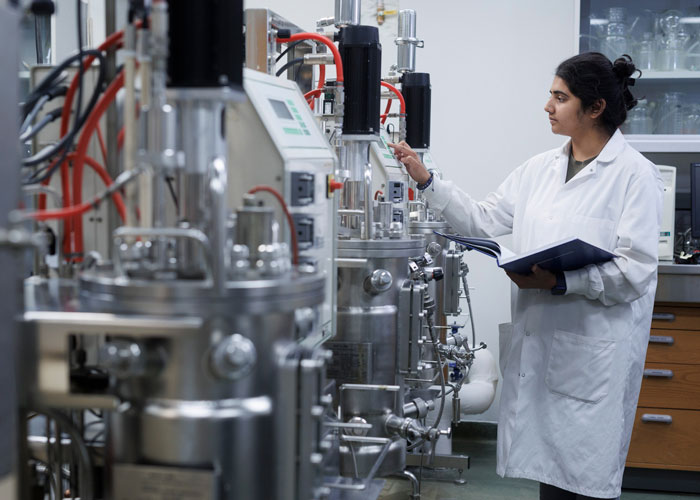
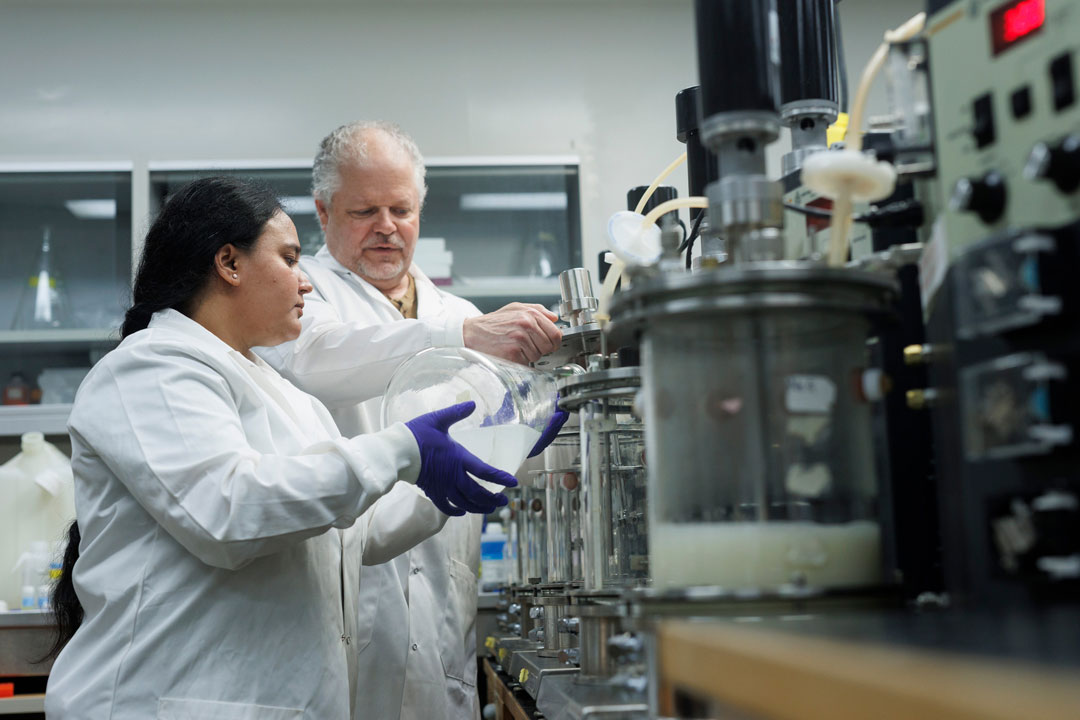
Another exciting development for the department has been the fermentation pilot plant, which has been updated in recent years with brand new equipment, technology and expertise.
This was an important move for the department, Korber said, as there has been renewed interest in this bioprocessing method in recent decades, given that it offers a natural, sustainable way to enhance nutrition, preserve ingredients and create new products with less environmental impact. It also enables the development of innovative plant-based foods, functional ingredients and bioplastics—helping meet global demands for healthier diets and greener technologies.
Now, one of the department’s main focuses is looking at the potential to use fermentation to optimize the potential of Saskatchewan pulse crops, often done in collaboration with faculty with expertise in proteins, enzymes and microbiology.
Pulse crops are often separated during milling processing into different fractions that include protein, starch, oil and fibre, Korber said. Protein-based fractions, the highest value component, can be incorporated into food and feed products to add a nutritional boost but they can also be poorly digestible and not nutritionally optimal.
“Using fermentation, we can improve digestion and get rid of antinutritional factors that interfere with digestion,” he said.
Other researchers, including Dr. Yongfeng Ai (PhD), are trying to figure out potential new uses for the starch-rich fractions of pulse crops.
“We’d like to improve the quality of that starch because right now it’s a low-value byproduct,” Korber said. “We can ferment the starch, along with inexpensive nitrogen sources, to convert it into microbial protein and we end up with a product that could be put into, say, an animal feed.”
More recently, the university has also begun contracting the lab out to third party companies who are looking for support in their own fermentation projects, which often includes de-flavouring or deodorizing food ingredients, or improving their nutritional profiles. This type of work can also include longer-term projects developing prototypes and testing them before investing in scaleup endeavours.
“These things don’t all happen at once with the snap of the fingers,” said Korber.
Perhaps one of the most important functions of the fermentation lab, however, is training the next generation of food and bioproduct scientists, who are already blazing trails and doing high impact work in their respective areas, Korber said.
In fact, this reflects one of the best parts of working in this program, in his opinion: faculty and students can follow their own paths and do research that reflects their personal interests or has special meaning to them.
“They can do whatever they envision, bounded only by their imagination,” he said.
One of the current members of the faculty is a perfect example of this. Dr. Christopher Eskiw (PhD), an expert in nutrigenomics, has explored a wide range of topics related to aging and dementia but more recently has diversified his research interests to include using yeast to increase the health of the gut microbiome in animal systems.
“Now he’s applying his high-powered nutrigenomics and genetics expertise to yeast and beer quality,” Korber said. “He’s leveraging his deep background in biochemistry and genomics to explore how gene expression in yeast influences beer traits—work that’s highly relevant to the needs of the competitive microbrewery sector.”
Eskiw also leads research related to how to process yeast to target different flavours in small-scale brewing operations.
This reflects another area of expertise of the program, Korber said, which has long supported the local craft and spirit brewing industry through research and innovation.
In light of this, the department launched its first undergraduate course specific to the topic this fall, alongside a brewing club that will begin January 2026. This could potentially lead to the development of a more formal program for the discipline if the interest continues, which Korber expects it will.
Given this diversity of options for study, and the importance of the research being done, Korber hopes more students will consider this discipline as a potential area of study going forward.
He also urges people to consider the experiences and impact they could have with a career in food and bioproduct sciences.
“There is just really cool stuff going on in our program, with excellent career options on the other side.”